Sunday, June 1, 2014

The Tramp and the Black Boxer

 
Film critic Matthew Dessem recently wrote that Buster Keaton's The Playhouse (1921) is "not particularly beloved today" because it features Keaton performing in blackface for a minstrel act.  Click here for the full article.  A reader, who calls himself Mr. Neutron, expressed doubt about this statement.  He wrote, "[The Playhouse is] still widely regarded as one of Keaton's most dazzling and creative shorts. Yes, the blackface act is disconcerting for a modern audience, but Keaton isn't using it for racist purposes.  Keaton's playhouse is full of the sort of acts one would expect to find in an old-time playhouse, and the blackface is just one of them.  Keaton's reliance on racist stereotypes in films like College is more objectionable, as is the anti-miscegenation gag in Seven Chances, though such material would have raised no eyebrows at the time."  I discuss the race issues of College and Seven Chances in my book The Funny Parts, but it never occurred to me that the minstrel scene in The Playhouse could qualify as racial humor.  It is Keaton using innovative camera tricks so that he can play all nine performers in a traditional minstrel act.  Nothing about the scene directly addresses race.


Of all the silent film comedians, Charlie Chaplin is one who usually falls under the radar in discussions of black stereotypes in silent comedy films.  Chaplin was well known for his left-wing political views.  He made it clear in his films that he opposed the idea of bullies, whether a street tough, a fascist government official or an unfeeling capitalist, victimizing the little guy.  So, then, what did he think about the civil rights of blacks in the United States?  I am sure that, if he was ever asked, he would have expressed his wholehearted support of blacks and other minorities.  The comedian appears to have been respectful of other races in that he didn't generally trade in ethnic humor.  But the fact was that blacks were generally absent from his films.  This sort of exclusion could be considered unfriendly to the black community.  Is it better to have black characters share in the pratfalls and other buffoonery or to render them virtually invisible?

I can think of only two instances in which a black character turned up in a Chaplin film.  The first time occurred in one of Chaplin's early Keystone comedies, His Favorite Pastime (1914).  It must be taken into consideration that the film was made before the comedian had control of his films.  The film largely represents the Keystone style of the day.  Let's go to the scenes in question.  While visiting a bar, Chaplin has an encounter in the bathroom with a black shoeshine boy.  The role is played by Billy Gilbert, a white actor in blackface.  It wasn't uncommon in 1914 to see a comedian in blackface in a film.  It should be noted, though, that, during this period, blackface entertainers were far more prevalent on the vaudeville stage than the movie screen.  Theater owners gave blackface singers and comedians prominent billing in newspaper ads because, for whatever reason, this was a form of entertainment that their patrons enjoyed.  By comparison, Hollywood went lightly on this form of entertainment.  In His Favorite Pastime, Gilbert manages in his portrayal of the shoeshine boy to slouch and shuffle, which is meant to indicate that the character is lazy.  He is dim-witted, too, based on his dull, slack-jawed expression.  We know that Chaplin's character has drank too much by the fact that he is stumbling around the bar.  In the bathroom, he bumps into a swinging door and loses his hat.  The shoeshine boy retrieves the hat for Chaplin and then grins unctuously in the hope of receiving a tip.  Chaplin glowers blearily at the shoeshine boy, who then makes his interest in a tip more obvious by holding out his hand.  Chaplin becomes so annoyed by this vulgar solicitation that he puts out a match in the shoeshine boy's hand.  Humor can be derived from a service worker annoyingly soliciting a tip without bringing race into it.  The use of this black character is, in the end, gratuitous and tasteless.


Later in the film, Chaplin performs an old stock routine in which a comedian comes up behind a shapely young woman and is shocked to discover that the woman is black.  The woman is played in blackface by a white actress, Helen Carruthers.  This is a more harmless routine, which I have discussed at length in The Funny Parts and previous blog posts.


To my knowledge, many years passed before another black character appeared in a Chaplin film.  That character was a boxer portrayed by an actual black actor, Victor Alexander, in City Lights (1931).  His appearance is brief.  Chaplin observes Alexander kissing his lucky rabbit's foot before a fight.  Chaplin is respectful towards the man and asks to borrow his rabbit's foot to bring himself luck in his own match.  The perception of black people as superstitious was stubborn, lingering in the minds of Hollywood screenwriters long after most other perceptions had been abandoned.  It isn't something that was necessarily wrong or evil.  The idea, simply, was that black people were spiritual and that spiritual people are more likely to put trust in unseen forces.  The boxer is ready for his fight.  He is vigorous and focused.  He is a much better representative of the black community than the blackface clown who shuffled around the bar bathroom 17 years earlier.  But the payoff of the scene is that the black boxer is dragged back into the locker room unconscious.  Maybe, a lucky rabbit's foot is not all that it's cut out to be.

 
I do not find the lucky rabbit's foot gag to be disconcerting or offensive.  Am I wrong?  My family comes from Naples, Italy, and Napolitanos have long had a reputation for being superstitious.  Would it offend me if Chaplin had made the boxer Italian?  No.  Of course, I have to admit that, if the Italian boxer was greasy and was waving around a lucky clove of garlic, I would have a different opinion.  But Chaplin is not out to make the boxer a grotesque figure.  The boxer is just man trying to bring some good luck his way.  I freely admit that I, myself, sometimes pray for good luck.  I prayed today because I learned that one of my Facebook friends had surgery.  Can a rabbit's foot be someone's prayer?  It's a hard question to answer.  The Civil Rights Movement was led by a spiritual man, Martin Luther King, Jr., who believed in the power of prayer.  I don't see him as a superstitious fool, but he might not be held in high esteem today if he brandished a rabbit's foot while he stood on the steps of the Lincoln Memorial and made his "I Have a Dream" speech.  Of course, King wasn't trying to get laughs.  Comedy is meant to be self-depreciating. 

My point is that a person should not be quick to dismiss a gag as racist and vile without stopping to consider if the gag unfairly degrades an entire race of people.  Examine the context of the gag before you condemn it.  What is the message?  What is the filmmaker's objective?  The minstrel act in Keaton's The Playhouse is a wonderful example of filmmaking.  It is clear in my mind that it is not racist. 

Simulated Scotch


A novel comedy routine showed up on theater screens in 1955.  Oddly, the routine was featured in two unrelated films, which happened to be released only two weeks apart.  In You're Never Too Young (1955), Jerry Lewis must hide the fact that he emptied a bottle of Scotch.  His solution is to cleverly mix products from a first aid cabinet to create a concoction that has the taste and color of Scotch. 

You're Never Too Young (1955)


In Mister Roberts (1955), Ensign Pulver (Jack Lemmon) has convinced a nurse to go on a date with him by promising to share a rare bottle of Scotch with her.  Unfortunately, the bottle that he expected to use is no longer available.  His friends, Roberts (Henry Fonda) and Doc (William Powell), come to his assistance by creating simulated scotch out of pure alcohol, Coca-Cola, iodine and hair tonic.

Mister Roberts (1955)


Funny Tidbits for June


Allow me take care of some miscellaneous business today.

Here is a Charley Chase performing the "trying on hats" routine in At First Sight (1924).


This is Buster Keaton performing an early version of his "unconscious woman" routine in The Navigator (1924).


A folding bed gets the best of Jerry Lewis in You're Never Too Young (1955).

  
Charlie Chaplin is still running afoul of his old nemesis, the dress dummy, in Monsieur Verdoux (1952).


Here are three brats from The Band Wagon (1953).

  
The Three Stooges perform the three-man human pyramid gag in Healthy, Wealthy and Dumb (1938).


I have written much about Karno's "Mumming Birds" sketch in the past.  I just recently learned Max Linder starred in an unauthorized film adaptation of "Mumming Birds" in 1907.  The film was called Au music-hall, which translates as At the Music Hall.
 
These stock comedy bits are further proof to me that comedians never tire of a good routine.


One last silly clip


Saturday, May 31, 2014

Merry Jerry


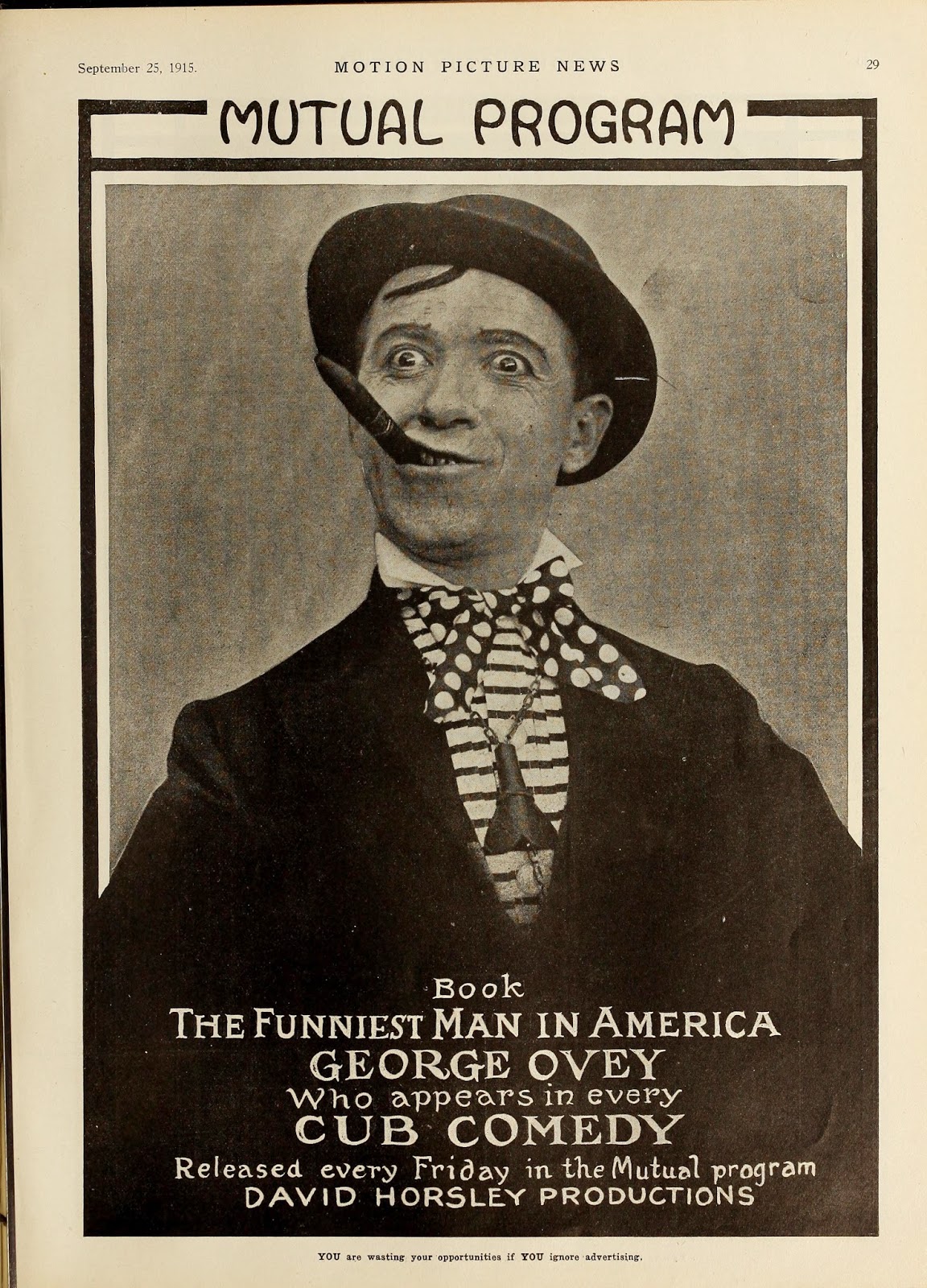
George Ovey starred as "Merry Jerry" in more than 100 Cub Comedies from 1915 to 1917.  He stood with both of his feet pointed inwards just like a later Jerry.


Here is a few production stills, ads and articles for the series.


An Oriental Spasm (1915)


 Jerry's Busy Day (1915)


The Hold-up (1915)


Taking a Chance (1915)


Jerry in the Movies (1916)


Jerry's Big Game (1916)


Jerry's Millions (1916)


Be Sure You're Right (1917)


Jerry's Brilliant Scheme (1917)


A clever reveal gag opens an unidentified Ovey comedy from 1917.


This is an older and wiser Ovey in a Three Stooges comedy.


Buster Keaton Joins a Drill Squad


I found an interesting quote from Roscoe Arbuckle in a Moving Picture World article titled "How Fatty Arbuckle Makes 'Love'" (March 8, 1919).  Arbuckle expressed his disappointment at Keaton leaving his comedy troupe to join a military unit in France.  "It is utterly impossible to replace him," he said.  "To my mind, Buster is the coming comedian of the movies and will be a very successful star."  Arbuckle was not likely surprised by Keaton's comedy supremacy of the 1920s.


Arbuckle said in the same interview, "I'll wager [Buster] is a great favorite with his company.  He can entertain them, all right!  By the way, he had a funny experience, or rather his drill squad did, when Buster first joined the army.  He was eager and anxious to learn but knew just about as little about handling a gun and about military tactics as the rest of the rookies.  In going through the drill, he unconsciously put in some of the funny steps and movements with which he was accustomed to [from] burlesque military exercises.  Everyone knew who he was and nothing but military discipline kept him from breaking up the show. When off duty, he was the best entertainer in camp, with his ukulele solos and his stock of natural comedy."  Keaton was later inspired by his experiences in France to make The Doughboys (1930).


The "Stop and Substitution" and "Reversal of Action" Camera Tricks


Monday, March 10, 2014

Harry Langdon in the Sound Era


A new YouTube channel, the host of which calls himself Johnny Flattire, is furnishing the general public with the sound films of Harry Langdon.  The sound and picture quality is not the best, but it was a thrill for me to have access to many films that I had never seen before.  I have decided today to select a number of scenes for discussion.       

Director Arvid Gillstrom did well with Langdon in two of these films, The Big Flash (1932) and Tired Feet (1933).  The Big Flash includes a series of vignettes.  At one point, Harry does his best to avoid falling into the embrace of a vamp.  This was a preoccupation for Harry in his silent films.  


Later, Harry has trouble operating a machine gun, which is reminiscent of a scene from Langdon's Soldier Man (1926).


Langdon continues to fall back on old material when he recreates a Long Pants routine in which he has to distract a police officer.

 
I like this scene in which Harry gets caught in the middle of a shoot out.  The joke is that Harry's hat flies into the air each time that the cop or robber fire their gun.  The scene also includes a sidewalk elevator gag that was used often in silent films.


I wrote about the classic water pump routine here and here.  Langdon biographers Chuck Harter and Michael J Hayde found that Langdon made use of this routine in his vaudeville act, Johnny's New Car.  Langdon performed variations of the routine in two of his sound shorts.  First, he puzzles over an uncooperative water faucet in Tired Feet.


Nine years later, an older and wiser Harry struggles to best a tricky water faucet in Tireman, Spare My Tires (1942).


These two scenes reveal the major changes that Langdon made to his comic persona during his Columbia series, which ran from 1934 to 1945.  Pre-Columbia Harry tries to make peace with the faucet, giving it a friendly pat, and eventually walks away resigned and befuddled.  Columbia-era Harry, who functions as a more conventional character, engages in a prolonged battle with the faucet and walks away frustrated and wet.

The climax of Tired Feet involves Vernon Dent forcing Harry to dress as a woman in a scheme to rid their camp of tramps.


Langdon opens Sue My Lawyer (1938) with an amusing bit in which he accidentally mistakes a ball of rubber bands for an apple and tries to take a bite out of it.  It isn't as funny as Stan Laurel eating a wax apple in Sons of the Desert (1933), but it got me to laugh nonetheless.


Unfortunately, I cannot offer praise for much of what follows the rubber band scene.  The problem is that Columbia producer Jules White didn't allow Langdon to do what Langdon did best.  Langdon had his own distinctive style, but you see little of his style in his Columbia series.  It often looks as if Langdon wandered in off the street and got caught up in a Three Stooges comedy.  Buster Keaton had the same problem at Columbia.  Don't get me wrong, I love the Stooges.  But it was wrong for the Stooges' style to become the house style of Columbia's short comedies.


Midway through Sue My Lawyer, Langdon recreates his classic Strong Man routine in which he carries an unconscious woman up a flight of stairs.  New to the routine is a dime-store corkscrew, which has been introduced to enliven the action.  The corkscrew pokes through Harry's coat pocket and it jabs the woman in the backside every time that Harry lifts his left leg to ascend the stairs.  This sort of comic mayhem, though suitable for the Stooges, only succeeds in distracting attention from Langdon's pantomime actions and emotional expression, which is what made the routine funny in the first place.  The fact is that the corkscrew gets more screen time than Langdon.


But, still, the scene is subtle compared to the comedy found in many other Columbia shorts.  The next time that Langdon grappled with an unconscious woman for Columbia, writers Monte Collins and Elwood Ullman made the point to enhance the comic action with an explosive current of electricity.

To Heir is Human (1944)


This is a familiar Commedia dell'arte routine used in Sue My Lawyer.


In the long history of comedy, no actor ever worked his forehead as vigorously as Monte Collins works his forehead in this scene. 

This film provided one other routine that I enjoyed.


This cracking walnuts routine had been used by other comedians in the past.  Lloyd Hamilton and Dick Sutherland performed the routine in a 1924 Educational comedy, Good Morning.

In Cold Turkey (1940), Langdon furnished the mirror routine in reverse.  Instead of mistaking another person for his reflection, he mistakes his reflection for another person.


This is the strangest version of Langdon's classic balloon routine.


Langdon performed a slightly better version of the routine a year later when he starred in the PRC feature Double Trouble (1941).


Later in Cold Turkey, Harry is looking to slaughter the turkey for dinner, but Monte Collins gets the mistaken impression that Harry is an axe murderer out to slaughter him.


The first gag of A Blitz on the Fritz (1943) has Harry getting stuck in a tire. Believe it or not, this gag is as funny as the film gets.


The scriptwriter, Clyde Bruckman, borrowed the film's climax from a 1919 Harold Lloyd comedy, From Hand to Mouth.  The scene worked well with Lloyd but was hardly suitable for Langdon.


Langdon was paired with British comedian Charley Rogers in a low-rent attempt by PRC to create their own version of Abbott and Costello.


PRC's House of Errors (1942) starts out with Harry struggling with mechanical devices, including a car horn and a vacuum cleaner.


Later, a criminal tries to use a fishing line to snatch a set of keys away from Harry.  He snags onto several items apart from the keys, reeling in a pocket handkerchief, a rug and Harry's hat.  Seeing these objects move across the floor or float into the air leads Harry to believe that he is being plagued by a poltergeist.  The scene reflects a direct Abbott and Costello influence.  Lou Costello was spooked by a moving candle in Hold that Ghost (1941) and now Langdon is spooked by a moving rug.


Comedy stalwarts Monte Collins and Vernon Dent help out in a scene set in a flophouse.  The scene starts out with Langdon acting opposite Collins, who plays the proprietor of a flea circus.


Next, Harry runs into problems with Dent, who falls asleep on his hand.


Here is an amusing routine performed by Langdon in another PRC feature, Double Trouble (1941).


Blonde and Groom (1943), which was written by Langdon, has a morbidly bizarre ending in which Harry is injected with a giant hypodermic needle and drained of more blood corpuscles than he can spare.  Harry is so anemic that, when his wife hugs him, he crumbles to dust.  The fact that the scene drags on for close to 3 minutes makes it especially gruesome.


I recently wrote an article for Tim Greer's Harry Langdon fan site, Feet of Mud.  The article can be found at http://feetofmud.com/2014/02/03/death-lust-betrayal-and-long-pants/.  I strongly recommend that you also take a look at the site's excellently illustrated filmography.