Saturday, April 28, 2018

Tidbits for April 2018

Leon Errol in We're Not Dressing (1934)
I wrote before about the history of television producers killing off series regulars.  I neglected to include an early and highly dramatic example in my discussion.  John McIntire wanted off the series Naked City.  He didn't like the frigid location shooting in New York and he missed his family in California.  Here is the way that his character left the show.


One of my favorite Max Linder comedies is Max, professeur de tango (1912).  The main scene involves Max's awkward efforts to give a dance lesson while inebriated.


This routine is marvelously expanded by Leon Errol in The Jitters (1938).


The longest-running thread on the Nitrateville classic film forum addresses the topic of the Murphy bed in films.  The thread has garnered 109,953 views and 271 comments in the last ten years. 

Here are a few Murphy bed scenes that I learned about from this thread.

A piano converts into a Murphy bed in Saturday Night (1922).


Patsy Kelly gets trapped beneath a Murphy bed in Sing, Sister, Sing (1935).


Danny Kaye gets closed inside a Murphy bed in Money on Your Life (1938).


Joan Blondell has difficulty pulling down a Murphy bed in The Amazing Mr. Williams (1939).


Nicholas Smith and Frank Thornton get shut up in a Murphy bed in 1973 episode of Are You Being Served? called "Camping In."


Fred Evans was famous in England for his work on stage and screen.  Here his talents are showcased in a 1915 film, Pimple Has One. 


The film includes a popular English music hall routine in which a drunk man gets his coat entangled around a lamppost.


From the drunk man's perspective, the sidewalk appears to be tilting one way and the other like a ship deck listing from bow to stern during a storm.  This routine, which has been discussed in a previous post, was used in many early films.


The film's most interesting gag involves Evans fretting over a brazen woman showing off her ankle.  He suddenly comes up with the idea of painting over the lens to obscure our view.


The same basic gag was later used by other comedians, including Roscoe Arbuckle and Buster Keaton.


Lupino Lane performs a variation of the classic Commedia dell'arte routine "Lazzi of Fear" in The Dummy (1916).  I have written about this routine in "The Funny Parts" and past blog posts (Check out one blog post here). 


The I Love Lucy writers had a knack for coming up with a funny scene to highlight an episode.  In the 1951 episode "Drafted," Lucy and Ethel invite guests to the Ricardos' apartment for a surprise party for Ricky and Fred, who they mistakenly believe have been drafted into the Army.  Ricky and Fred see their teary-eyed wives knitting blankets (which they intend to give to their husbands as a going-away present) and assume that the wives must be crying and knitting blankets because they are pregnant.  Ricky and Fred invite guests to a surprise baby shower on the same night as their wives' surprise going-away party.  Lucy and Ethel's strategy for hiding their guests is to hurriedly shove them, one by one, into a hallway closet.  Ricky and Fred have the same idea, shoving their guests into the same closet.  In the end, the party guests get tangled up together within this terribly cramped space.


A similar scene turned up more than twenty years later in a Here's Lucy episode.     

Here's Lucy ("Lucy Plays Cops and Robbers," 1973)

 
 Various party guests get stuck together in a closet in a 2014 episode of Inside No. 9 called "Sardines."


Danny Kaye, Vivien Leigh and Laurence Olivier dressed up as children for a benefit.


Here is a full-page trade magazine ad for Universal's popular comedy team Lyons and Moran.


The Orgamatron in Woody Allen's Sleeper (1973) was based on real-life device, Wilhelm Reich's Orgone Accumulator.


I thank Jorge Finkielman for these images from Skirts (1921).


Footage deleted from Skirts ended up in a two-reel comedy called The Singer Midget's Scandal (1921).


A screen capture of Victor McLaglen and Edmund Lowe in Under Pressure (1935).


Basil Radford and Naunton Wayne, a comedy duo brought together by Alfred Hitchcock for The Lady Vanishes (1938), were still a feature attraction more than a decade later in It's Not Cricket (1949).  The blonde bombshell applying for a job with the men is Diana Dors.


Sid Caesar and Imogene Coca perform a unique version of "Slowly I Turned" for Your Show of Shows.


Patsy Kelly tries on hats in Sing, Sister, Sing (1935). 


The following clip features André Deed as a reporter trying to sneak into a news-worthy wedding.


Inflatables humor is back in Johnny English Strikes Again (2018).


Veronica, a 2017 horror film that has been gaining many fans on Netflix, features a Ouija scene.


"The Old Bazaar in Cairo" was a popular song in England.  Here are four renditions of the song.

Charlie Chester


Joan Savage and Ken Morris


Johnny Farnham


Cilla Black and Roy Hudd


The Mirror Routine at The Circus

Martino and Alexander (2015)
The Gotys Clowns


Illi and Olli at Circus Roncalli


The Shepperd Clowns


The Capital Circus of Budapest 


The mirror routine is adaptable to all forms of theatre.

Stuart Robson and William Crane in William Shakespeare's "The Comedy of Errors" (1888)

Silent Comedian Portraits

Here are portraits of silent film comedians that I found in a 1920 periodical "Who's Who on the Screen."


I always enjoy to find a photo of Larry Semon.  Here are a few more.


Slap Happy

Glenn Ford and Rita Hayward in Affair in Trinidad (1952)
A Madison Avenue man, Gene Case, developed the "Thanks. . .  I needed that" campaign for Mennen's Skin Bracer aftershave.


The idea of slapping a hysterical person to compose them had been circulating in films and literature for years.

Here is a passage from the 1939 novel "Ten Little Indians":
She began laughing wildly again.  Dr. Armstrong strode forward.  He raised his hand and struck her a flat blow across the cheek. She gasped, hiccupped – and swallowed.  She stood motionless a minute, then she said, "Thank you. . . I’m all right now."  Her voice was once more calm and controlled - the voice of the efficient games mistress.
Robert Mitchum and Jean Simmons in Angel Face (1953)


John Wayne and Robert Stack in The High and the Mighty (1954)


Tippi Hedren and Doreen Lang in The Birds (1963)


Dewey Martin and Mary Murphy in The Outer Limits ("The Premonition," 1965)


Marlo Thomas and Ted Bessell in That Girl ("Don't Just Do Something, Stand There," 1966)


Zero Mostel and Gene Wilder in The Producers (1967)


George C. Scott and Tim Considine in Patton (1970)


Tony Randall and Al Molinaro in The Odd Couple ("The Flying Felix," 1970)


Marlon Brando and Al Martino in The Godfather (1972)


Lucille Ball and Gale Gordon in Here's Lucy ("Lucy Plays Cops and Robbers," 1973)


Jack Nicholson and Faye Dunaway in Chinatown (1974)


John Cleese and Connie Booth in Fawlty Towers ("The Builders," 1975)


Sissy Spacek and Betty Buckley in Carrie (1976)


Leslie Nielsen and Lee Bryant in Airplane! (1980)


Cher and Nicolas Cage in Moonstruck (1987)


Holly Hunter and Brad Bird in The Incredibles (2004)


So, now, you know how to handle an hysterical person.  I am glad that I could help.


The Spencer Bell Misidentification Syndrome


This is NOT Spencer Bell
One of the best known black comedians of the silent era was Spencer Bell, who achieved prominence while engaged by producer Jack White from 1922 to 1926.  While at White's Fine Arts Studio, Bell played a sidekick to Lige Conley in a series of Mermaid Comedies.


Bell and Conley functioned as a virtual comedy team.  This became evident to me when I enjoyed the team in a double feature, Wild Game (1924) and Below Zero (1925), at the Museum of Modern Art.  According to film history researcher Carlos Devanti, the team was billed in Italy as Pick and Puck.


The man hanging from the plane in this ad for Air Pockets is Bell.


Here are news articles that specifically identify Bell in this role.


Here is a screen capture of Bell hanging off the plane.


A second black actor, Henry Trask, also hangs off the bottom of a plane in this film.


Trask is mentioned in yet another news item.


Today, no reliable credit listing exists for Bell.  The Internet Movie Database lines up 78 actor credits for the funnyman, but the list is not entirely an accurate record.  To start, it is reasonable to assume that not all of Bell's screen appearances are identified on the list.  This is a common problem when it comes to credits for the supporting players of the period.  At this time, acting credits were limited to the lead actors and the lead support.  But a less common problem also mars the data.  A question has recently been raised among film historians if it is possible that many of the roles attributed to Bell belong to other actors.  Useful information has come from several sources, including Tommie Hicks, Richard Roberts, Robert Moulton, Lord David Heath and Steve Rydzewski.

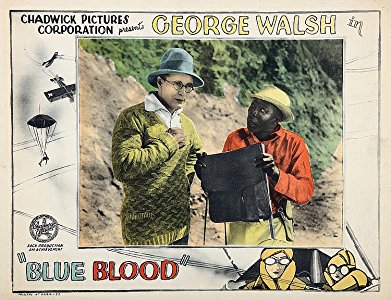
In 1925, Chadwick Pictures Corporation circulated press releases for a black contract player billed under the gag name "G. Howe Black."


It has long been believed that G. Howe Black was actually Bell.  But comparing screen captures of Bell and screen captures of Howe show distinct physical differences between the men.

Bell is credited by IMDb with appearing in eight Larry Semon comedies from 1922 to 1924.  But screen credits do not verify this claim outright and a careful examination of the films has raised doubt in my mind that the black actor in the Semon films is Bell.  From what I can see, the actor bears a strong resemblance to Curtis McHenry, a high-spirited comic actor who often played servant roles in Christie comedies.  McHenry did receive credit in one Semon comedy, Stop, Look and Listen (1926).


Let's talk a bit about McHenry.  McHenry transitioned from the circus to films in 1920.  He started with the L. K. O. series and soon moved to the Century Comedies, where he was known as "Snowball."  This is a 1922 news item in which "Snowball" is praised for performing "death defying stunts" with lions.


The comedian's affinity to animals is demonstrated by this news item found by Moulton.


McHenry is mostly recognized today for his work in the Christie comedies, but the comedian often remained nameless despite his stand-out work for the studio.  A review for the 1925 Christie comedy Call a Cop reports: "A colored comedian does some excellent work in a 'scared to death' scene with a skeleton." 


McHenry is identified in an on-screen title for Christie's Goofy Ghost (1928).


An exhibitor, who no doubt took notice of the credit title, went on to praise McHenry's work in the film.


McHenry is also known for having played Friday in Bryan Foy's 1924 satire of the classic "Robinson Crusoe" novel.


Other black comedians received better press attention in the Hollywood press during this period.


So, let me provide screen captures from the various (mostly fuzzy) prints and you can decide for yourself if Bell deserves all of his IMDb credits or if many of these credits in fact belong to McHenry.

We know for sure that Bell appeared in the following films:

Ten Dollars or Ten Days (1924)


Lizzies of The Field (1924) 
 

Fast and Furious (1924)


The Outlaw Dog (1927) 


Mickey's Luck (1930)


Smart Money (1931)


We know for sure that McHenry appeared in the following films:

The Lyin' Tamer (1926)


The Great K & A Train Robbery (1926) 


Isle of Sunken Gold (1927)


Hold 'Er Cowboy (1928)  


Goofy Ghosts (1928)

So, fine, you now know what Bell and McHenry look like.  Here is the uncredited actor that appears in Semon films from 1922 to 1924:

The Counter Jumper (1922) 


Horseshoes (1923)


Lightning Love (1923)


No Wedding Bells (1923)


The Gown Shop (1923)


Kid Speed (1924) 

Her Boyfriend (1924)


Dome Doctor (1925)


The Cloudhopper (1925)


Here is the actor billed as G. Howe Black:

The Wizard of Oz (1925) 


Blue Blood (1925) 


The Perfect Clown (1925) 


Keep in mind is that the character is called "Snowball," which was McHenry's usual name on screen.


What do you think?


Additional notes

This article, which is dated December 4, 1920, was uncovered by Robert Moulton.


The article is important as it may identify two black comedians that have remained unknown for decades.  Film historians have questioned who played Buster Keaton's caddy in Convict 13 (1920).

 
This just might be Thurston Brooks, who we now know from the article was working with Keaton at the time.  Convict 13's caddy bears a distinct resemblance to an uncredited comedian who acted as Larry Semon's sidekick in The Sportsman, which was filmed the same month that this article was published.


It is noted in the article that a black comedian working with Semon at the time was Huel Brooks.  Could the actor in The Sportsman be Huel Brooks?  I also cannot help but wonder if Huel Brooks and Thurston Brooks are the same man.


At the time, audiences couldn't always tell the difference between a white actor in blackface and an actor with a natural black coloring.

    
Tom Wilson, best know as the cop who tormented Charlie Chaplin in The Kid (1921), adopted blackface for several film roles.


Wilson appeared in blackface in Fox's Goodbye Girls (1923).  An exhibitor in Baltimore reported, "Tom Wilson, negro comedian, keeps 'em laughing from start to finish."

Charles "Heinie" Conklin appeared in blackface in George Washington Jr. (1924).  A Detroit exhibitor wrote, "[T]he colored comedian carries off the bacon."  An Akron exhibitor noted, "The colored comedian is the whole show."  An exhibitor from Conway, New Hampshire, declared, "Colored comedian kept audience in a roar."


Update (May 8, 2018): I acknowledged in this article that an important source of information was Steve Rydzewski, but I failed to clarify that Rydzewski was the first film historian to specifically identify G. Howe Black as Curtis McHenry.