Sunday, June 30, 2013

YouTube Presents Hungry Lions, Exploding Cars and a Child-rescuing Chimp


It amazes me that I can go on YouTube every few months and find rare silent film comedies.  My latest YouTube search turned up five interesting films.

1.) The Lyin' Tamer (1926)

The "lion comedy" is well represented by this 1926 Fox Imperial comedy.  Michael Rogge, who posted The Lyin' Tamer on YouTube, admitted that he did not recognize the star of the film.  One commenter thought it was Raymond Griffith, which is reasonable as the actor does bear a passing resemblance to Griffith.  But the actor is, in fact, Ernie Shields.  Shields may be a mysterious figure today, but he became a familiar face to film fans of his day after starring in nearly eighty Universal comedies from 1914 to 1919.

The Lyin' Tamer is effective even though it is hardly original.  The following routine from the film falls squarely into the conventional category. 


Abbott & Costello still had use for the routine more than twenty years later when they made the jungle comedy Africa Screams (1949).


Here we have yet another routine that The Lyin' Tamer borrowed.


The business of a fake lion and a real lion engaging in a mirror routine had been done the year before in the Roach comedy Sherlock Sleuth (1925).  The man dressed as a lion in this clip is Curtis McHenry.  

The tilting house routine that appears in the final clip was another well-worn bit of business.  The routine was discussed previously on this blog.  But at least the filmmakers attempted to heighten the suspense by incorporating a lion and a flood into the action.


2.) What Price Goofy? (1925)


Here is a classic scene from The Awful Truth (1937).  The premise is clever.  A dog misunderstands the intentions of its owner and plays a risky game of hide-and-seek with an incriminating article of clothing. 


The director, Leo McCarey, had originally developed the routine for a Charley Chase comedy, What Price Goofy? (1925).  The film presents just the sort of domestic crisis known to plague Chase.  As a favor to a friend, Chase invites a professor to stay at his home.  When he learns that the professor is a beautiful woman, he decides that it would be better to keep her presence a secret from his jealous wife.  He has a burglar, of all people, pretend to be the professor.  We have no bowler hat in the scene.  Instead, Chase struggles to keep a female undergarment hidden.


3.) Shine 'Em Up! (1922)


The obvious lesson to be taken from Shine 'Em Up! (1922) is that some people are overly sensitive to racial slurs.  Paul Parrott is trying to draw business to his shoeshine stand, but calling out "Shine!" is somewhat imprudent when the word "shine" is also an offensive reference to a black person.


4.) The Grocery Clerk (1919)


You are likely familiar with this scene from Alfred Hitchcock's The Birds (1963). 


Now, let's take a look at a similar scene that is less well known and much less serious.

Larry Semon in The Grocery Clerk (1919)


The scene is artfully designed.  An insert shot shows that gasoline leaking from an old man's can is creating a puddle at Semon's feet.  The old man carries the leaky can to his car, leaving a stream of gasoline behind him.  Semon lights his cigarette.  The flame of the dropped match ignites the gasoline.  The fire follows the gasoline stream to the car, causing an explosion.  This scene demonstrates that suspense works as well in a comedy as it does in a thriller. 


Semon could never resist using a routine that had worked for him before.  Let's look at a later version of the "gasoline stream" routine from Semon's The Hick (1921).


This isn't as funny to me as the earlier version.  I preferred Semon's thoughtless, cocky fool causing the accident rather than becoming the hapless victim of the accident.  Also, the scene isn't set up in a way that creates suspense.  Semon introduces too many distracting elements into the action.  He frantically drives off as the irate father is firing a shotgun at him.  A bullet punctures the gas tank.  Then, abruptly, the father realizes that he is out of bullets and decides that this would be a good time to have a smoke.  Semon, who just avoided being fatally shot, inexplicably climbs into the backseat of the car and plays "she-loves-me-she-loves-me-not" with a daisy.  Gunfire.  Car escape.  Daisy plucking.  As this is going on, it's easy to forgot that Semon's car has left behind a stream of gasoline and the gasoline can be ignited by the match that the father is about to toss to the ground.  To work, the scene depends on a focus so intense that it is unnerving.  All that matters at the moment is the match and the stream of gasoline.


5.) The One Best Pet (1920)

I'm not sure of the title of our last film today.  My best guess is that it is a 1920 Chester comedy called The One Best Pet.  I recognize the star of the film for sure.  That mangy-looking chimp can be none other than Snooky (also known as "Snooky the Humanzee").

 
I am not ashamed to say it, I am vastly entertained watching Snooky climb up to a roof to rescue a befuddled toddler held aloft by balloons.  Everything about this comedy looks sketchy from a child safety perspective - the gunfire, the rooftop antics, and certainly the lion leaping and clawing to get at a small child.


Also, I must add, watching Snooky having to contend with this rambunctious horse made me fear for the chimpanzee's life.


A DVD collection of Snooky comedies is available from Looser than Loose.


What treasures will you have for me next time, YouTube?


Thursday, June 27, 2013

Doll Abuse


In Superman III (1983), a young mother enters a park pushing a baby carriage.  She lifts a toddler out of the carriage and sets him down on a see-saw.  Suddenly, a stolen money bag drops from a scaffold and lands full force on the upended end of the see-saw, causing the other end to fly upwards and humorously catapult the toddler into a tree.  Do not fret, though, as the toddler is represented by a blatantly obvious doll.  For years, comedians have tossed, kicked, dumped and stomped baby dolls for laughs.  No comic prop has been more maltreated than the baby doll.  Is this a little sick?  I do my best in The Funny Parts to explain the routine and describe the many gleeful ways in which comedians have roughed up these faux infants.  Evidently, this business never gets old.  Take a look at this clip from a recent episode of Curb Your Enthusiasm ("Mister Softee," 2011).


Bill Buckner, a former first baseman best known for a fielding error that cost the Red Sox the 1986 World Series, has been redeemed.  A happy ending for all even though the doll got shaken up in the process.

Jerry Seinfeld said, "The comedy universe is a swamp of madness."  He expressed this opinion to David Letterman during an episode of Comedians in Cars Getting Coffee ("I Like Kettlecorn," 2013).  Letterman agreed with Seinfeld, stating that funny routines often come from "guys. . . [with] personality disorders."  He brought up, as an example, spastic standup comedian Lenny Schultz.  He recalled a night in the 1970s when he was at the Comedy Store and saw Schultz running around on stage with a baby doll.  Letterman said, smiling, "[He] has a little toy whip and he's whipping the baby. . . [Y]ou hear the sound effects of a crying baby."  Letterman could not have looked more pleased as he finished the story.  Yes, whipping a baby doll is great fun.  It's madness, but fun.  

The ultimate example of this routine was featured in a devilish 1915 Vitagraph comedy called Boobley's Baby.  The plot is simple.  Sydney Drew is pretending that a baby doll is a real baby so that he can get a seat on a trolley.  A woman who Drew has been romancing sees Drew with his "baby" and, assuming that he is a married man, becomes furious with him.  Drew is upset that his romance has come to an end and he takes his frustration out on the doll.  Steve Massa wrote in Lame Brains and Lunatics, "[W]e see Sydney throttle and tear the arms and legs off the doll (which really looks like he's murdering a baby)."


A baby doll suffers a similar fate in a 2011 episode of The Middle called "The Big Chill."  Laziness and selfishness cause high school sophomore Axl to grow hostile towards a baby doll placed under his care as part of a health class project.  The unwanted doll, which falls victim to increasingly abusive treatment from its impatient caretaker, ends up being decapitated and dismembered.


 A practice baby doll is not entirely safe even in the hands of a well-intentioned expectant mother.


 I Love Lucy ("Pregnant Women are Unpredictable," 1952)


More doll-catapulting can be found in this scene from Naked Gun 33 1/3: The Final Insult (1994).


As I said before when discussing the "wedding attack" routine, sometimes dark currents of human psychology are the reason for the enduring popularity of a routine.


You can read more about this perverse phenomena of baby doll thrashing in The Funny Parts, which is available at Amazon.com.


Wednesday, June 26, 2013

No Smoking


In The Duck Hunter (1922), Billy Bevan's efforts to enforce a "no smoking" policy in his barber shop lead to a surreal battle of wills with Jack Cooper. 


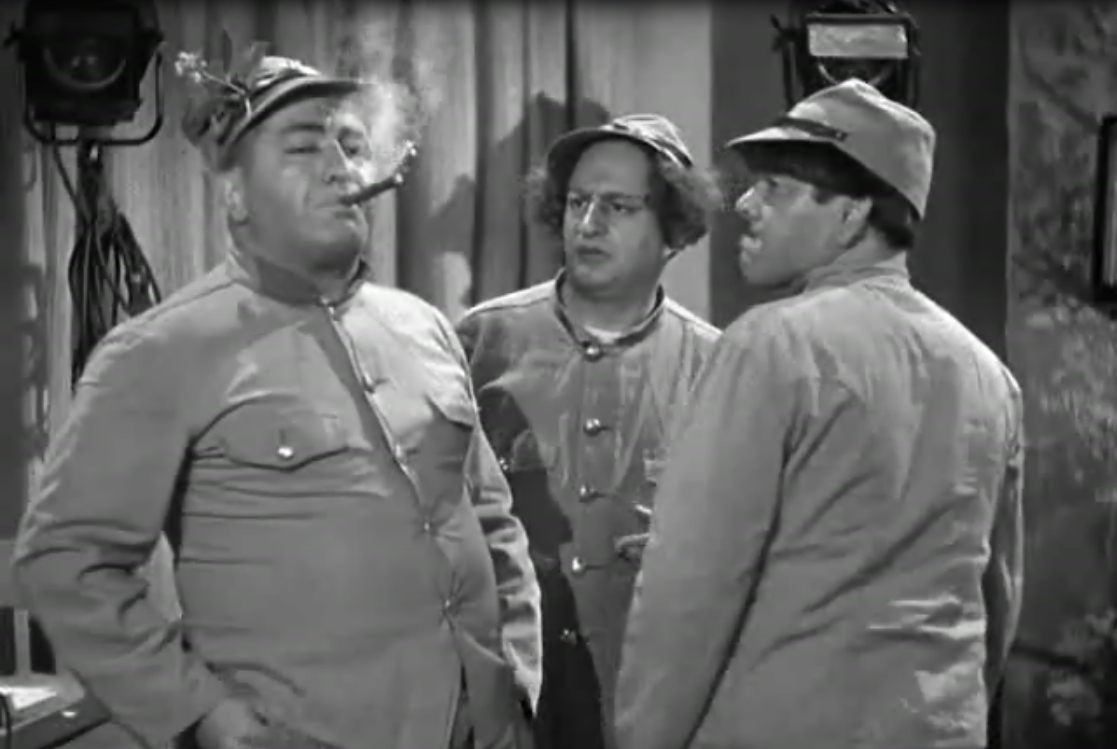
The routine was later reprised by the Three Stooges in No Dough Boys (1944). 


But, interestingly, the Stooges did not borrow this old comic business outright.  They started out with another routine that, although similar enough, maintained a distinct identity of its own.  It was over a span of eight years that the two routines finally merged into one.  If I was a wise old professor, I would call this comedy convergence.

 
Movie Maniacs (1936) 


Three Sappy People (1939) 


So Long, Mr. Chumps (1941)


The Brides Wore Blue


I recently discovered a 1920 Roach comedy called Money to Burn. This film, which lasts under 9 minutes, is a succession of stock gags and routines.  Take, for example, this routine in which Snub Pollard hides under a trash can to avoid getting bitten by a dog.


Harold Lloyd cleverly expanded the routine in Among Those Present (1921).


It is well-constructed scenes like this one that gave Lloyd his elevated status in the comedy field.  But a Money to Burn scene that caught my attention even more is a variation on the "bridal chase" routine.  It is usually a horde of prospective brides that chase after the comedian, but this time Pollard is chased by an anti-masher police unit composed entirely of women.


The Horse in the Floral Print Dress


Buster Keaton's Our Hospitality (1923) includes many great gags, but the following gag has always been one that stood out.


A rowdy slapstick version of the gag, which ends with the horse kicking the villain to the ground, is initiated by dude-turned-cowboy Johnny Arthur in the Tuxedo comedy Honest Injun (1926).  Harold Lloyd effectively reworked the gag for The Kid Brother (1927).

 
While working as a gag man on A Southern Yankee (1948), Keaton handed down the time-tested gag to a next-generation comedian, Red Skelton.


Tuesday, June 25, 2013

I Love Sushi


The Nickelodeon sitcom Drake and Josh staged a homage to I Love Lucy's famous chocolate factory routine in a 2006 episode called "I Love Sushi."  


I Love Lucy ("Job Switching," 1952)


Drake and Josh ("I Love Sushi," 2006)


As a child, I appreciated the pressure that Lucy and Ethel were under to wrap the chocolates before they sped past on the conveyor belt, but I still thought it must be fun for these ladies to stuff their mouths full of chocolate as a way to hide the pieces they couldn't wrap in time.  Others must have felt the same way as they now sell Lucy Chocolate Factory chocolates.


It is more gross than funny to see Drake and Josh with raw fish and seaweed hanging out of their engorged mouths.  It makes me cringe even more to watch the boys hide slimy cuts of fish by throwing them in the air and getting them to stick on the ceiling.  The selection of props can definitely change the character of a routine.   


In rare cases, a gag or routine is so inextricably tied to its originator that the only way that another comedian can repeat this business is to present it in the form of a homage.  No gag has inspired a greater number of homages than Buster Keaton's falling building gag, which was a subject that I discussed in a prior article.

I thank jayessell for identifying two more examples of animators using this gag.


 My Little Pony: Friendship is Magic ("Too Many Pinkies," 2012)


Aladdin (1992)


I have also come across two instances in which this gag was used by modern sitcoms. 


Arrested Development ("The One Where They Build a House," 2004)


The Middle ("The Name," 2013)


The Incredible Inedibles


A memorable scene in Saps at Sea (1940) features Laurel and Hardy cooking up an impromptu meal for a snarling gangster who insists on being fed.  Lacking actual food, the boys make a spaghetti and meatball dish using a sponge for the meatballs, string for the spaghetti and grated soap for the cheese. A precedent for this routine can be found in a 1927 Pizor comedy called Lunches and Punches.  Sid Smith, a lunch counter cook, is at odds with a rough, ill-tempered customer who insists that Smith serve him shredded wheat.  Smith finds that he is out of shredded wheat and, to avoid the customer getting violent, he fixes up broom bristles to look like the fibrous cereal.


Saps at Sea provided a clever twist to the routine.  The gangster learns of Stan and Ollie's deception and forces them to eat their synthetic (or, as Stan says, "sympathetic") meal.