Monday, October 12, 2015

The Rise of the Comedy Feature, Part 2: The Year of the Ladies


We left off in my last article at the end of 1915.  Nothing particularly notable happened during the next year.  John Barrymore starred in an amnesia comedy called The Lost Bridegroom (1916), after which he left behind comedy business for serious roles.  Douglas Fairbanks produced several highly successful comedy features during the year.  He produced a new feature nearly every month.  The best of these films included Her Picture in the Papers, Reggie Mixes In, Flirting with Fate, Manhattan Madness, American Aristocracy, The Matrimaniac and The Americano.  Otherwise, the comedy feature went into a period of inactivity in 1916.

June Caprice and Frank Morgan in A Modern Cinderella (1917).
Renewed interest in the comedy feature didn't come about until the following year.  A trend developed in 1917 with comedy features that centered on young women.  The plots either had to do with a spoiled, rebellious heiress who has to be tamed for the plot to reach a satisfying resolution or a working girl who falls in love with an heir or a nobleman and has to overcome class conflicts to live happily ever after.  The critics clearly identified the bad traits of the spoiled heiress.  June Caprice's heiress in The Mischief Maker is "always impulsive;" Ann Murdock's heiress in Please Help Emily is "willful;" Jackie Saunders' heiress in Betty Be Good is "impulsive and mischievous;" and Margarita Fischer's heiress in Molly, Go Get 'Em is "irrepressible."  These traits are the reason that these young women are always getting themselves into trouble.  It takes the right man to bring out the loving and steady woman dormant inside these wild and bratty girls.  The working girls found their rich Prince Charming in a steady stream of films, including Sally in a Hurry, A Modern Cinderella and The Upper Crust.  The actresses who played the most dominant role in the woman comedy trend were Saunders and Fischer.  The busier of the two was Saunders, who turned out three consecutive comedy features: Sunny Jane, Bab the Fixer and Betty Be Good.

Margarita Fischer
The comedy drama still had very little comedy.  Take, for instance, The Fibbers (1917).  A struggling young architect, Peter Cort (Bryant Washburn), and his wife, Barbara (Virginia Valli), find an old tramp living in an abandoned freight car and take him home to care for him.  They discover that the tramp has a drug addiction and, although they are struggling financially, they pay for the tramp to receive medical attention.  The tramp is grateful.  He reads a play that Barbara has written and advises her to submit the play to a famous theatrical producer.  The play sells and, shortly after, Peter is contracted to build a home for a wealthy woman.   The couple return home on the night that Barbara's play premieres and find that their tramp friend is missing.  The producer of the play arrives and explains that the tramp was once a successful businessman and he contacted old friends to bring about the couple's recent good fortune.  Poverty, homelessness and drug addiction does not create a great triple play for laughs, but an occasional humorous touch was no doubt introduced to lighten the mood.

Comedians pratfalled enough in the short films that preceded the features to make it seem excessive to continue with pratfalls in the feature presentation.  So, the comedy that turned up in features remained light.  The comedy feature of the time was designed to be, as Moving Picture World noted, "a distinct departure from the hackneyed slapstick, pie-throwing, funny-walk type of comedy."

People who went to see these films did not expect a funny, action-packed climax.  A light comedy had a polite resolution to mix-ups, revelations and charades.  Blushed cheeks would accompany the confession of a secret.  A hug or a handshake would resolve a misunderstanding.  There were no car chases or tumbles down hills.  But, of course, there was a rare exception.  The climax of High Speed (1917) was similar to the climax that later turned up in Harold Lloyd's Girl Shy (1924).  The American Film Institute describes the scene as follows: "Just as the ceremony is about to take place, Susan [the bride] experiences second thoughts and calls Speed to save her.  True to his name, Speed whisks Susan from the altar and carries her away to elope."  Bringing Home Father (1917) had an even livelier finale.  An alderman candidate who advocates Prohibition secretly enjoys the occasional night of drinking.  His wife throws a reception to promote his campaign, but a man who the candidate has wronged spikes the punch, which causes the reception to turn into a drunken melee.

Let us look at a sample of other comedy features that were released in 1917.


The Girl Who Couldn't Grow Up (produced by Mutual Film Company)

Peggy Brockman (Margarita Fischer) finds her idyllic life disrupted when her long-widowed oil magnate father remarries.  She struggles to adjust to her new social climber stepmother and her two new snobbish stepsisters.


The Mischief Maker (produced by Fox Film Corporation)

While at boarding school, Effie Marchand (June Caprice) poses for her sculpting teacher.  The teacher has only completed his statue's head when he finds himself overcome with lust and attacks Effie.  The young woman is able to fight off her teacher before a visitor arrives at the studio and rescues her.  The teacher later turns his sculpture of Effie into a nude statute, which causes Effie to get expelled from school and disgraces the young woman with her mother.  I will leave it to the American Film Institute to explain the film's denouement:
Effie then begins a romance with Al, and when they get married, Effie's mother takes the wedding as just one more sign of her daughter's impulsiveness.  Mrs. Marchand soon finds out, however, that her new son-in-law is the man she had chosen for Effie long before, and so mother and daughter are quickly reconciled.

A Game of Wits (produced by American Film Company)

On the verge of financial ruin, Cyrus Browning (George Periolat) forces his daughter, Jeanette (Gail Kane), into a marriage with Silas Stone, who the American Film Institute describes as "an aged Wall Street wolf."  Jeanette is determined to outwit the crafty old man.  The American Film Institute notes, "Jeanette pairs her youthful strength against the old man's advanced age.  After tiring him out with dances, midnight suppers, swims and horseback riding, Jeanette plays her trump card when she introduces Stone to her brother Larry, the shame of the family because of his insanity which she claims to have inherited as well.  Horrified, Stone attempts to steal away but is caught by Larry.  Jeanette feigns despair at the loss of his love and threatens to sue for breach of promise."  Once Stone pays Jeanette $100,000 to squash the suit, it is revealed that her insane lover is actually her perfectly sane sweetheart.

Miss Deception (produced by Van Dyke Film Production Company) 

The American Film Institute summarizes the plot as follows:
When Joyce Kingston [Jean Sothern], who has been living in the Kentucky hills with her Uncle Ed, is summoned to her father's city home, she learns that her high toned family believes that her years of country living have rendered her a hick, and so, not wanting to disappoint them she decides to play the role of a country bumpkin.  Although finely educated and a stickler on etiquette in her uncle's home, Joyce pretends to be illiterate and offends everyone with her crudeness.  Joyce's antics alienate her father's fortune-hunting fiancĂ©e Genevieve, who thinks that Joyce is a barbarian.  Believing that Kingston is about to lose his wealth, Genevieve breaks her engagement, and Joyce's happiness is made complete when her sweetheart sees through her bumpkin act and proposes marriage.
Little Miss Fortune (produced by Erbograph Company)

Sis (Marion Swayne), a maid at a theatrical boardinghouse, reveals astonishing acting ability as she rehearses lines with a boarder, Jim.  The couple fall in love as Jim helps the maid to pursue an acting career.


The Broadway Sport (produced by Fox Film Corporation)

Hezekiah Dill (Stuart Holmes), a milquetoast bookkeeper at a flour mill, dreams of traveling to Times Square.  One night, Dill catches a pair of burglars breaking into the company safe.  He locks the burglars in the safe and impulsively snatches their loot to finance a trip to the big city.  Motion Picture News reported, "Once in sight of Times Square [Dill] catches the spirit of the locality and blossoms into a real sport.  In fact, he hits such a hot pace that it is difficult to believe in his experiences."  You would be right not to believe in his experiences.  As it turns out, the whole big city adventure was a dream.  However, Dill wakes up in time to catch real-life burglars breaking into the company safe.  He captures the burglars, for which he is proclaimed a hero.

The start of 1918 saw no revolutionary changes in the comedy or the comedy drama feature.  Let us look at three examples.

 
We can start with Jack Spurlock, Prodigal (1918).  The film's set-up is aptly described by Hal Erickson as follows: "An incurable cut-up, Jack Spurlock throws a college campus in an uproar when he shows up the first day of classes with his pet bear.  Needless to say, Jack is immediately booted out of college, infuriating his big-businessman father (Dan Mason)."  Father puts Jack to work as a purchasing agent at the family's wholesale grocery business.  But Jack makes the mistake of ordering 200 carloads of onions, which gets his father so mad that he exiles his son to heavy labor at a warehouse out of town.  At the warehouse, Jack falls in with union organizers, who delegate him to act as a strike representative.  This manages in the end to get Jack fired from the family business.  Jack is working at a cheap cafe when he has a chance encounter with Professor Jackson.  The professor, a manufacturer of patent medicines, mentions to Jack that he uses onion juice as the principal ingredient in his latest mixture.  Jack quickly gets the idea to sell the professor his father's surplus of onions.  This puts Jack back into his father's favor.  His father sees that his boy has business sense after all and he reinstates him at his old job.  A bear walking around a college campus is funny.  Carloads of onions are funny.  But there is no way to say exactly how funny this film was from the plot description alone.


Our Little Wife (1918) had an undeniably screwball plot.  Exhibitors Herald noted, "Dodo (Madge Kennedy), just married and seeing the unhappiness of three of her former suitors, decides to take them along on her honeymoon.  Herb, the husband, has little to say, but his efforts to rid himself of Dodo's 'boys' almost results in a divorce."


Real Folks (1918) was an anti-snob story.  Exhibitors Herald noted, "Real Folks is an entertaining story of a father who suddenly becomes rich and endeavors to bring his family into society. . . [W]ith many humorous twists and turns the story ends in a fashion pleasing to all and highly amusing to spectators."  The ending might not actually be pleasing to everyone.  The family goes back to their old lifestyle just to get away from the snobs.


Sennett successfully joined the women's comedy trend with Mickey, which turned out to be the highest grossing film of 1918.  Though distinct in its own ways, the film stuck to the essential formula.  The title character of Mickey, played by Mabel Normand, is a downtrodden working girl who ends up marrying a millionaire.

Mabel Normand in Mickey (1918).
In 1918, John Ford directed Harry Carey in a pair of Western comedies, Wild Women and Roped.  Wild Women was the sillier film.  A cowboy celebrates his win at a rodeo with a visit to a Hawaiian-style cabaret.  The cowboy drinks too many Hawaiian cocktails and passes out drunk.  He becomes shanghaied during an extremely sound sleep and, once he is awakened, he is forced to perform menial duties on a ship.  Later, when the crew mutinies, he becomes abandoned on a Hawaiian island.  An aging queen demands that he marry her, but he is more interested in the queen's pretty young daughter.  In the end, the cowboy's island adventure turns out to be a dream.

Charlie Chaplin in Shoulder Arms (1918).
Everything changed with the October release of Chaplin's war comedy Shoulder Arms.  Film critic Paul Tatara sees Shoulder Arms as "one of Chaplin's early masterpieces."  He wrote of the film, "[It] nonchalantly moves between sentimentality, comic violence, and outright surrealism without losing sight of its serious subject matter.  The fact that it ended up being one of the biggest hits of Chaplin's hit-laden career suggests that he knew exactly what he was doing when tackling such a risky topic. . . Shoulder Arms isn't much of a narrative, but at 40 minutes, it really doesn't have to be.  It's basically an opportunity for Chaplin to riff on the absurdities of army life and modern warfare."


Sennett followed Shoulder Arms with his own comedy feature about the war.  He essentially garbed the Keystone Cops in German military uniforms and let them run amok in muddy trenches and battlefields.  Yankee Doodle in Berlin (1919) represents, according to Emory University film historian James Steffen, "the lighter side of the hate-the-Hun propaganda films which proliferated after America's April 1917 entry into World War I."  Steffen pointed out that Sennett's bathing beauties played an important role in the promotion of the film.  He wrote, "The Bathing Beauties became one of his most lucrative promotional tools, touring the country in special road show events that accompanied screenings of Sennett's films.  Yankee Doodle in Berlin was no exception: not only did the Bathing Beauties appear on stage, but the film's lead actor, the professional female impersonator Bothwell Browne, performed an 'Oriental dance' for audiences."

The slapstick comedians who dominated the short subject market were slowly but surely moving into feature films.  The King-Bee Film Corporation announced that they would produce a five-reel burlesque of "Romeo and Juliet" starring Billy West.  It may have seemed like a good idea for a slapstick comedian to have the support of Shakespeare's highly regarded prose when he embarked on his feature film debut.  The film, though, never materialized.  Mr. and Mrs. Sidney Drew were willing to forsake their usual humor to make a feature for Metro.  They turned out a melodrama called Pay Day (1918).

Louise Fazenda in Down on the Farm (1920).
It was more than a year after the release of Yankee Doodle in Berlin that Sennett released another feature.  He kept the action at home this time with a spoof of the hackneyed rural melodrama called, simply, Down on the Farm.  The plot remained within familiar guidelines.  A lecherous banker will discard the farmer's overdue mortgage if he is permitted to marry the farmer's daughter (Louise Fazenda).  But the farmer's daughter remains loyal to her "rustic sweetheart," played by a lumbering Harry Gribbon, and she tries her best to outwit the banker.  The film was, according to Sennett historian Brent Walker, "one of the most profitable pictures Sennett would ever make."

Harry Gribbon is about to bring down a mallet on Jimmy Finlayson in Down on the Farm (1920).
Gribbon was an outstanding comic actor.  James Roots, the author of The 100 Greatest Silent Film Comedians, wrote that watching Gribbon was "like watching John Wayne trying to play Larry Semon."  Within two months after appearing in Down on the Farm, Gribbon turned up again in another comedy feature, Fine Arts Pictures' Up in Mary's Attic.  Internet Movie Database describes the plot as follows: "Living in a private school while awaiting the fortune she will inherit if she remains unmarried until she's 21, Mary is not only already married, but has a child with her gym teacher husband [Gribbon].  About to be discovered by the conniving son of the principal, they hide the baby in the attic of her dormitory."


Critics found the film to be a vast improvement to Down on the Farm.   The New York Review stated, "Up in Mary's Attic beats Mack Sennett at his own game. . . This facially melodramatic, human-interest picture has about all the elements necessary for a hilariously thrilling screen hour — a triumph for Eva Novak, Harry Gribbon and Elmer J. McGovern.  Up in Mary's Attic is something new in five-reel comedies and should be booked by every exhibitor because it is novel and artistic."  No critic would ever think to call Down on the Farm novel and artistic.


This was exactly the response that the film's distributor, Nat Robbins, had hoped to receive.  "Up in Mary's Attic," said Robbins, "contains everything that a feature should.  There is rollicking comedy without any slapstick, and in addition, considerable dramatic situations, pathos and heart appeal which will register big with every audience."  Motion Picture News similarly noted that the picture contained "a wealth of humor, heart interests, thrill and suspense."

Sennett had showed Hollywood that the best way to promote a comedy feature was with bathing beauties.  In much the same way, Fine Art Pictures' publicity department focused attention on their own bathing beauties.  They wrote, "A particularly interesting feature of Up in Mary's Attic is the fact that more than a hundred of the most charming and bewitching bathing beauties it was possible to assemble form a graceful background for much of the action and the development of the story.  Each one of this bevy passed muster in the judgment of a number of judges of feminine beauty before being given a part in the picture.  They are the liveliest, most bewitching set of sirens who ever faced a camera, according to those who have seen the picture."  But it wasn't only the bathing beauties that bewitched the critics.  One critic of the day wrote, "[I]t is difficult to tell which is the cutest — the hundred bathing girls, the baby, Harry Gribbon, Eva Novak or the dog!" 

Exhibitors Herald reported, "There is one unusual phase in the screen entertainment offered in Mr. [Murray W.] Garsson's presentation, and that is that Up in Mary's Attic is a comedy photoplay with a plot, one that can be followed with interest even if interrupted frequently with bursts of laughter. . . There is, also, an unexpected smoothness in the continuity for a play of its kind."


The best review came from Motion Picture News' Laurence Reid, who wrote the following:
It looks as if the five reel comedy is here to stay.  Mack Sennett experimented beyond the short reelers some time ago and enlarged his reputation to some extent, although the subject matter of his ideas belong in pieces of two reel length.  Up in Mary's Attic is the newest five reel comedy and it is surely going to be heard from because it is based primarily on lifelike action, the burlesque incident being only secondary in capitalizing values.  There is nothing of the slapstick about it.  The humor is not gained by pie-slinging methods or by a heterogeneous group of grotesque comedians giving chase to one another.  Its mirth-provoking qualities are founded on an incident of life that is reasonably true.

You may call the picture a polite comedy — a satirical comedy — a melodramatic comedy and not go wrong on either count.  Place a delectable type of femininity in a boarding school — bring out that she is married to the athletic instructor and will forfeit her inheritance and be expelled if the marriage leaks out — introduce a cute infant for unconscious humor and juvenile appeal — present a galaxy of the girls as the student body and you Have an idea that spells a comedy with a purpose.  Take away the melodramatic trimmings and the bevy of "BeeVeeDee'd" beauties and any good director could fashion from the subject matter a bright and merry farce comedy.

The high spot in this offering is the aforementioned baby who enacts her scenes in a fine spirit of playfulness.  Extremely provocative of laughter is her mother's attempt to hide her away from those who are not "in the know."  Mary finds a safe place for her in the attic of the dormitory where an intelligent dog acts in the capacity of nurse.  There are a number of effective scenes like this one.  But for those who like their comedies dressed up with feminine pulchritude let us state that Up in Mary's Attic keeps to the standard set by Dr. Ziegfeld on the stage.  They gambol on the beach, cut up high jinks in the gym and give the comedy a good deal of its appeal.  Eva Novak and Harry Gribbon arc the featured players and they give an excellent account of themselves, the former lending tone and quality through her charm and sincerity, while the latter furnishes fun in his droll buffoonery.  It is a comedy of situations and surprises.  Not forgetting the baby.
Gribbon, the buffoon from Down on the Farm, achieved an effective balance with the sweet and lovely Novak.  But Gribbon was not the only person in this production who was experienced with broad comedy.  Novak had started out as a Sennett bathing beauty and, not long after, she received thorough slapstick training working opposite Gribbon at the L-KO company.  The film's director, William Watson, was well known at this point for directing animal comedies at Universal.

Eva Novak
Up in Mary's Attic was, as Exhibitors Herald stated, an "unusual phase in screen entertainment."  This was the first stirrings of the new era of the comedy feature.  It was the light comedy with Sennett elements introduced.  You had the bathing beauties, the animal antics and the slapstick comedian, but you also had a believable story, sympathetic characters and well-structured acts ("smoothness in the continuity").  It was not the random episodic comedy of Down on the Farm.

A scene from the Lyons and Moran's first  feature, Everything But the Truth (1920).  The actors are, left to right, Anne Cornwall, Lee Moran, Katherine Lewis and Eddie Lyons.
 In 1920, Universal produced five feature comedies starring the comedy team of Lyons and Moran.  Roscoe Arbuckle, a master of slapstick, had starred in four feature comedies for Paramount from late 1920 to early 1921.  But Universal and Paramount made sure that their comedy stars restrained themselves.  These films furnished subdued situation comedy rather than roughhouse action.  But, thanks to Chaplin and Sennett, the timidity for slapstick-dominated features had already begun to fade away.

The Rise of the Comedy Feature, Part 1: The Demi-Clowns of 1915


It is widely believed that Keystone's Tillie's Punctured Romance (1914) was the first feature-length comedy film.  This is not exactly true.  More knowledgeable silent film enthusiasts have tried to make a finer and more accurate distinction by calling the film the first feature-length slapstick comedy.  Wikipedia plays it entirely safe by calling this melodrama spoof "the first feature-length film produced by the Keystone film company."

Mabel Normand, Charlie Chaplin, Marie Dressler and Edgar Kennedy in Tillie's Punctured Romance (1914).
A number of comedy features came before Tillie's Punctured Romance, but the Keystone feature was something that stood apart from the rest.  Unlike the previous comedy features, it pursued laughs with silly costumes, grotesque make-up, and riotous activity.  The cast engaged shamelessly in anything-for-a-laugh antics.  It was, to put it simply, pure comedy.  Prior to Tillie's Punctured Romance, film companies regarded this sort of broad and blatant comedy as inappropriate content for a prestigious feature film.  When producing a comedy feature, filmmakers favored restrained and lighthearted storytelling that focused more on developing characters and generating sentiment than stimulating laughs.  The action was devoid of the illogic, the exaggeration and the implausibility that was typically found in a Keystone comedy.  It did without the constant surprises and various incongruities that placed Keystone's characters and situations outside of everyday reality.  What the film companies chose to produce were light comedy features (emphasis on light) and comedy-drama features (emphasis on drama).  It was a light comedy, Paramount's Brewster's Millions (1914), that to my knowledge was the first feature-length comedy film that was ever produced. 

The next comedy feature prominent on comedy fans' radar is Charlie Chaplin's Shoulder Arms (1918), but many comedy features were produced between Tillie's Punctured Romance and Shoulder Arms.  A surge in comedy features occurred in the months that followed the release of Tillie's Punctured Romance, but not a single studio rushed forward to replicate the rough-and-tumble formula of the Keystone farce.  Sennett, himself, did not attempt another film like this for more than four years. 

The comedy feature films of the period mostly involved romantic couples hopelessly entangled in farcical complications.  Among these films were Mrs. Plum's Pudding, The Tale of the Night Before and Over Night.   Let’s take, for instance, the plot of Over Night.  Two couples are boarding a steamboat to Albany when one of the women realizes that she left a piece of luggage on the dock.  In the ensuing effort to retrieve the woman's luggage, the husband of one couple and the wife of the other couple get separated from their respective mates.  At the close of the scene, they find themselves stranded on the dock as the ship sails away without them.  Their shipbound spouses pose as husband and wife throughout their voyage to avoid a scandal.  Complications build upon complications.  Wikipedia summarizes the last act of the film as follows: "When the boat docks, [the couple learns] that the last train left.  Forced to spend the night in the hotel, they continue in their fiction.  The next morning, arriving at Albany, they are shocked to see the other couple posing as newlyweds as they stroll hand in hand through the hotel lobby.  The catch, however, is easily explained and the two couples, finally reunited, are recomposed."


No one slipped on a banana peel at any point in the story.  The filmmakers preferred comic complications over comic bits.  The situations, no matter how restrained, still retained a decidedly humorous flavor.  Can we fairly distinguish between pure comedy, as Tillie’s Punctured Romance might be described, and pratfall-free quasi-comedy, as Over Night might be described, and then separate the two into distinctively different categories?


In 1915, Moving Picture World reported, "John Barrymore will gladden the hearts of the many film followers in an indescribably funny picturization of Leo Ditrichstein's celebrated farce, Are You a Mason?"  The American Film Institute described the plot of Are You a Mason? as follows:
While his wife Helen is away visiting her mother, Frank Perry [Barrymore] is nearly arrested when he accidentally enters the wrong house after a night of drinking at his New York club.  When Helen returns, Frank tries to pretend that the incident was an initiation rite of the Masons, a society to which his wife has always wanted him to belong.  When Helen comes home, she is accompanied by her father who also has pretended to be a Mason for years.  Each man acts out supposedly secret Masonic rituals while the other imitates him.  After a variety of misadventures, including blackmail, Frank is allowed to join the Masons by Bob Trevors, a real member who wants to marry Helen's sister Nora.
As most feature-length comedies of the period, Are You a Mason? was adapted from a Broadway play.  Film studios recognized that Broadway farces provided proven stories and characters for the new long-form comedies.  Of course, the farces were accompanied by the farceurs.

Alonzo Price, John Barrymore and Henry Hull in the play "Believe Me Xantippe" (1913).
Barrymore had made light domestic comedies his specialty on Broadway.  Before he was engaged as a film actor by Famous Players, Barrymore had his greatest success on stage as the star of the light comedy "The Fortune Hunter," which ran for 345 performances at Broadway’s Gaiety Theatre.  Are You a Mason?, much like "The Fortune Hunter" and the actor’s earlier Famous Players' film American Citizen (1914), had no boisterous comedy in it at all.  It had none of the boldly ambitious set-pieces that would later be found in Harold Lloyd's Safety Last! (1923) or Buster Keaton's The General (1926).  It was appropriately described by film historian Hal Erickson as "inconsequential fluff."  Are You a Mason? is hardly a comedy in the sense that Chaplin's Shoulder Arms (1918) is a comedy.  Barrymore cannot pretend to be a clown next to a funny little guy who dresses up as a tree.


Walter Kerr had a name for the light comedy actors.  He called them "demi-clowns" because they were too normal to be regarded as full-fledged clowns.

Clown v Demi-clown: W. C. Fields and John Barrymore
Are You a Mason? does, however, include one stock routine shared by Barrymore and Chaplin.  Erickson wrote, "[D]irector Thomas M. Heffron attempted at one point to stage a drunk scene from the drunk's besotted point of view."  This, as the critic noted, was also a routine that Chaplin later performed in One A. M. (1916).  Besides the drunk routine, the secret rituals scene described by the American Film Institute could qualify as an appropriately silly and unbounded comedy routine.  So, does this nudge the film out of the category of demi comedy and into the category of pure comedy?


As long as we are talking about film adaptations of Broadway plays, it should be noted that Tillie's Punctured Romance was based on the Broadway play "Tillie's Nightmare," which starred the incomparably talented Marie Dressler.  It was inevitable that Dressler would be called upon to recreate her stage role for the film adaptation.  The opening scene of the film explicitly shows Dressler making a transition from the story's original stage setting to its new film setting.


In 1915, Douglas Fairbanks made a highly successful film debut in The Lamb, an adventure comedy in which a dangerous situation motivates a weak-willed mama's boy to release his inner grit.  By the final reel, Fairbanks has completed a dynamic transformation into an undeniably masculine hero.  This film belongs to the same lineage as Keaton and Lloyd's features.  Keaton in fact remade The Lamb as his first feature film, The Saphead (1920).  Both Keaton and Lloyd later used key elements of the Lamb’s engaging formula to generate their most successful features, including Girl Shy (1924), The Navigator (1924), The Kid Brother (1927) and Steamboat Bill Jr. (1928).


In considering these facts, it may not be fair to call Fairbanks a demi-clown.  Fairbanks could be as playful as Chaplin. . .


he could be as unexpected as Keaton. . .


and he could be as resourceful as Lloyd.


The other actors who starred in feature-length comedies this year were mostly like Fairbanks and Barrymore.  They were handsome and gracious men who didn't take pratfalls.  They had sidekicks to do that.

"The Galloper," Richard Harding Davis’ 1906 Broadway farce, was adapted into a feature film by PathĂ© Exchange.  The lead role was played by Clifton Crawford, a Scottish actor who first became popular singing and telling jokes in English music halls.  Crawford was best known for introducing the song "Pack Up Your Troubles in Your Old Kit Bag" in the Broadway musical "Her Soldier Boy."  The Galloper film, like the play, used the 1897 Greco-Turkish War as a backdrop.  A young American millionaire impersonates a disreputable war correspondent to travel into the war zone and meet up with a beautiful Red Cross nurse that he encountered in his recent travels.  Again, complications build upon complications.  To start, the nurse is not really a nurse.  She lied her way into the war zone to dig up a hidden treasure.  Also, Greek military officials are looking to execute the journalist for his unfavorable reporting.  The filmmakers added a funny Turkish spy to the story to bring a bit of broad comedy to the proceedings.


The Moving Picture World praised Crawford for his "brilliant work."  The magazine added, "Clifton Crawford proves himself to be an artist of the first rank."

Crawford abandons a hunting trip to Africa to follow a nurse to a war front in Athens.
Noted humorist George Ades had a success on Broadway with his 1912 play "Just Out of College."  Charles Frohman, who produced the play, turned out a screen version through his film company Frohman Amusement Corporation.  W. Stephen Bush of The Moving Picture World wrote of the film, "There is no pretense at anything like strong dramatic action; indeed the whole performance is or at least is intended to be pure comedy. . . Here and there the full force of the Ade humor breaks through and at such moments no audience can help enjoying itself and being noisy in its demonstrations of approval."

 
Take note, Bush described the film as "pure comedy."  Let us take a look at the plot to make sure.  A young college graduate, Edward Swinger (Eugene O'Brien), is intent on marrying Caroline Pickering (Marie Wells), but her rich businessman father Septimus Pickering (Ben Hendricks) doesn't see Edward as being worthy to marry his daughter.  Pickering, who has established a pickle empire, has developed a large ego in his rise to the top.  He now takes great pride being known in the business world as "The Pickle King."  During a visit to Pickering’s office, Edward meets Mrs. Jones, who worked as a housekeeper at his old boarding house.  Mrs. Jones has failed in an effort to sell Pickering on her special brand of pickles.  Edward figures to make an impression on Pickering by using Mrs. Jones’ recipe to launch a rival pickle company.  He invests the only money that he has on making a showy presentation of his proposed Bingo Pickle Company at the Pure Food Exposition.  He gets attention by having models dressed in beautiful costumes parade on the exposition floor.  Pickering becomes so worried that Edward will lure his customers away from him that he agrees, on the spot, to buy out the young man’s interest in Bingo Pickle.  Film historian Jim Beaver aptly summarized the film's plot on the Internet Movie Database: "Edward Swinger contrives to win the hand of the lovely Caroline Pickering by selling her father his business - a business that doesn't actually exist."  That plot is, indeed, pure comedy.  

Gertrude Kellar, Sydney Deane, Wallace Eddinger and Carol Hollaway in Gentleman of Leisure (1915).

Broadway veteran Wallace Eddinger took the lead role in A Gentleman of Leisure, an adaptation of a P. G. Wodehouse novel produced by Jesse Lasky.  The essential plot is similar to the plot of Just Out of College.  A young millionaire, Robert Edgar Willoughby Pitt (Eddinger), finds himself charmed by the lovely Molly Creedon (Carol Hollaway), who is the daughter of Deputy Police Commissioner Phillip "Big Phil" Creedon (Frederick Montague).  Pitt figures to earn the man’s respect by outwitting him with a bold criminal endeavor.  He goes on to wager a friend that he can rob the police commissioner’s house without being arrested.  Along the way, he gets help from a professional burglar, Spike Mulligan (Billy Elmer).  The Spike character is able to furnish the rougher comedy.  The Pit role was previously played on stage by Fairbanks (New York's Playhouse Theatre, 1911) and Barrymore (Chicago’s McVicker's Theatre, 1913).

Frank Daniels as Abel Conn in the play "The Idol's Eye" (1897).
Possibly closer to Kerr's notion of a comedy star was Frank Daniels, who looked funnier and acted funnier than either Barrymore or Fairbanks.  Daniels was featured in Vitagraph’s Broadway Star Feature Crooky (1915), the plot of which involved an escaped convict who steals the identity of a wealthy rancher.  In the film, Daniels showed his adeptness at relatively restrained, character-driven comedy.


Daniels quickly followed up Crooky with a second feature, What Happened to Father? (1915).  Daniels had been retired from acting when Vitagraph persuaded him to star in Crooky.  After making two feature films, the veteran actor abandoned the rigors of feature films and settled into making a series of short comedies.  He returned to the pleasure and serenity of retirement in 1919.
 
A retired Frank Daniels in 1933.
Even more clownish than Daniels was Victor Moore.  Producer Jesse Lasky contracted Moore for five features - Snobs (1915), Chimmie Fadden (1915), Chimmie Fadden Out West (1915), The Race (1916) and The Clown (1916).


The Lasky Company made a special effort to promote Moore's debut outing, Snobs.  The plot pointed to the difficulties that a man can have rising up from middle class to upper class.  The film opens in the law offices of Mr. Phipps (Ernest Joy).  Phipps is gloomy because his business is on the verge of bankruptcy.  He sees no way out of his financial straits until he learns that a milkman, Henry Disney (Victor Moore), is heir to the title and fortune of the late Duke of Walshire.  The lawyer arranges for his sister to seduce Disney, but it isn't long before Disney realizes that the young woman is only interested in his money.  Unfortunately, she is not the only one who pretends to like Disney in the hope of attaining a monetary benefit.  According to the American Film Institute catalog, "the social snobs. . . . fawn at him but mock him behind his back."  Disney gets fed up with his rapacious admirers.  Erickson wrote, "[I]n the film's dramatic highlight, [Disney] tells off an assemblage of aristocrats at a fancy-dress ball."  A critic with the Lompoc Journal reacted enthusiastically to Moore's performance.  He reported, "Moore, fortunately, has just the kind of expressive face and rollicking personality which surely ‘goes over’. . . He can’t exactly be compared with any comedian now on the screen.  He sets a new style — and doubtless be paid the tribute of having many imitators. . . [H]e is so full of humor and ‘snap’ combined."  For all of his snap, Moore took no pratfalls throughout the story and the reviews indicate that the best parts of his performance came out of his dramatic moments in the film. 


Moore's next film, Chimmie Fadden, was also well-received.  Moore’s title character, Chimmie Fadden, is a good-hearted Irish immigrant.  Fritzi Kramer, the author of the Movies Silently blog, wrote, "Chimmie rescues a rich do-gooder from a Bowery masher and is engaged as a footman in her house.  However, Chimmie’s brother has conspired with another servant to relieve the rich lady of her silver.  Chimmie must save his brother – and himself - when he is accused of the robbery!  DeMille and Moore made sure that Chimmie was funny but not slapstick. . . Chimmie Fadden received excellent reviews, with Moore in particular receiving praise for his funny and touching performance."

Joe Welch was an acclaimed stage comedian who specialized in playing downtrodden Jewish merchants.  His gloomy catchphrase was "I vish dot I vas dead!"  Welch had come to bring poignancy to his merchant character after he moved from vaudeville to the Broadway stage, where he starred in "The Peddler" and "The Shoemaker."  In 1915, Welch was contracted to star in a six-reel feature called Time Lock No. 776 (originally titled Going Big).  The film provided no hint of comedy whatsoever.  The actor, with all of his funny quirks, had been subsumed by the drama.  It seemed inevitable at the time that the comedy aspects of Welch’s sympathetic merchant would be diluted by the dramatic elements that were required to develop a long-form story.  It took Chaplin, Keaton and Lloyd to figure a way to build a credible, meaningful and affecting story around a clown character without losing sight of the tomfoolery.


As I bring this article to a close, I still cannot say for sure that Chimmie Fadden belongs in the same category as Steamboat Bill Jr.  But Chimmie Fadden was undoubtedly a comedy film and its genial star, Mr. Moore, was nothing less than a comedian.  Moore proved for decades that he had no problem making an audience laugh. 

William Gaxton and Victor Moore in Leave It to Me! (1938).

It is wrong for film historians, including myself, to leave Chimmie Fadden or Are You a Mason? or The Lamb out of discussions of Hollywood's comedy feature.

Douglas Fairbanks in The Mystery of the Leaping Fish (1916).

Additional notes


Entertainment history is filled with sad stories.  Clifton Crawford suffered a tragic death only five years after making The Galloper.  His death is explained plainly on the Internet Movie Database: 
Fell 60 feet to his death from his room at the Queens Hotel in Leicester square.  The coroner of Westminster ruled his death accidental, finding no evidence that Crawford was suicidal or drunk, only that he may have been under the influence of a sedative.  On his death one reporter wrote, "An evening with Clifton Crawford drove away the little troubles and annoyances of life; and a man that can do that can ill be spared."

Sunday, October 11, 2015

The Rise of the Comedy Feature: Introduction


On October 23, Open Road Films will release a new Bill Murray comedy, Rock the Kasbah.  This is yet one in thousands of comedy features that have been released in the United States during the course of film history.


The feature film comedy had its 100th anniversary last year.  Just as anything else in our lives that is overly familiar, it is easy for us to take the comedy feature for granted.  It is normal for a person to see this form of entertainment as something that has always been around and always will be around.  But a comprehensive examination into the origins of the comedy feature will reveal the awkward struggle that filmmakers had in introducing the long-form comedy film to the marketplace.

Join me tomorrow for the start of a three-part article on the rise of the comedy feature.


I mentioned in a recent post that Peter Reitan has written an excellent series of articles on the pie-in-the-face gag.  His latest article has special significance in that it provides a photo of the first Pie-in-the-Face Recipient and a photo of the first Pie-in-the-Face Thrower.  I advise you read the article at http://esnpc.blogspot.com/2015/09/homelessness-hunger-and-domestic.html.


I will close today with a few magazine clippings.

Lloyd Hamilton lunches with a faux Teddy Roosevelt in The Movies (1925). 
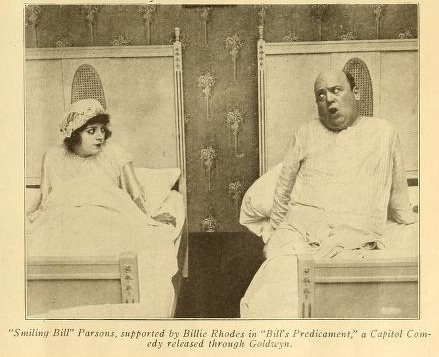
A wife and husband (Billie Rhodes and Smiling Billy Parson) sleep in separate beds in Bill's Predicament (1918).
Hank Mann struggles to rescue Madge Kirby from the electric chair in Mystic Mush (1920).
Hugh Fay and Neely Edwards get into the spirit-summoning business in the Hall Room Boys comedy Tell Us, Ouija! (1920).
Here is more action from Tell Us, Ouija! (1920).
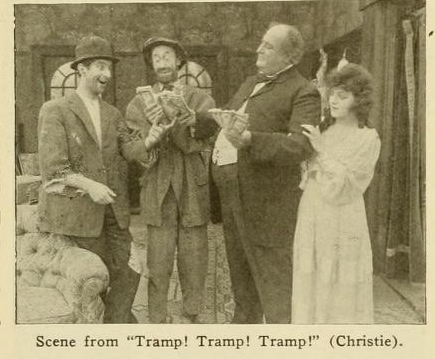
George B. French, Eddie Barry, Harry L. Rattenberry and Billie Rhodes in the Christie comedy Tramp, Tramp, Tramp (1916)