Monday, June 2, 2014

1979: A Funny Year


Film comedy has had exceptionally productive years: 1925 (The Freshman, The Gold Rush and Seven Chances), 1927 (The Kid Brother and The General) and 1933 (Duck Soup and Sons of the Desert).  But the most prolific year for Hollywood comedy surprisingly came years after the passing of Buster Keaton, Charlie Chaplin, Harold Lloyd, The Marx Brothers, and Laurel & Hardy.  The year was 1979.

In the film industry, the biggest comedy stars of the 1960s were Jerry Lewis, Peter Sellers and Jack Lemmon.  But the careers of these actors wound down in the 1970s and the time came for these old masters to pass the torch to a new generation of actors.
Blazing Saddles had been a phenomenal success in 1974.  It looked as if the film's director and co-writer, Mel Brooks, was destined to inherit the comedy crown.  However, the inspiration of Blazing Saddles proved to be limited and short-lived.  A sprinkling of parody films, including Young Frankenstein (1974), The Adventure of Sherlock Holmes' Smarter Brother (1975), Murder by Death (1976), The Big Bus (1976) and The Last Remake of Beau Geste (1977), were released to a mixed response over the next three years.

 
A much greater impact was achieved four years after Blazing Saddles by National Lampoon's Animal House (1978).  It's not that Animal House was the only successful comedy of 1978 (three other laughable crowd pleasers of the year were Foul Play, La Cage aux Folles and Up in Smoke), but it was Animal House that created an explosion in popular culture, clearing the way for a new wave of comedy films.  This was the year in which Hollywood learned that they could have a box office hit with a Not Ready for Primetime Player from Saturday Night Live.  Not only did John Belushi become a movie star with Animal House, but Chevy Chase became a movie star with Foul Play.  Let's take a look at the next year.  The number of notable comedies that was produced that year was thirteen.  Here is the list:

Being There (1979) 
The In-Laws (1979)
The Jerk (1979)
Love at First Bite (1979)
Manhattan (1979)
Meatballs (1979)
Monty Python's Life of Brian (1979)
The Muppet Movie (1979)
1941 (1979)
Real Life (1979)
Rock 'n' Roll High School (1979)
Starting Over (1979)
10 (1979)

That is an impressive group of films.  By sheer volume, no other year can match that record.  Just as remarkable as the quality of the films was their diversity.  This group of films included a sex farce, a dark satire, a musical free-for-all, a relationship comedy, an historical takeoff, a horror parody, and a puppet romp.  Manhattan could not have been more different than Meatballs.  Monty Python's Life of Brian could not have been more different than The Muppet Movie.


Saturday Night Live remained the biggest influence this year.  Veterans of the series were featured in six of these comic films, The Jerk (Steve Martin), Meatballs (Bill Murray), Real Life (Albert Brooks), The Muppet Movie (Steve Martin, again), Starting Over (Candice Bergen) and 1941 (Dan Aykroyd and John Belushi).  Film historians have often cited the failure of Steven Spielberg's 1941, but the film actually made substantial profits overseas and it has accrued its fair share of fans over the years.


Except for Brooks, members of Blazing Saddles' creative team had by now moved away from the parody genre.  Gene Wilder and Richard Pryor recently enjoyed great success with the comedy-thriller Silver Streak (1976).  Andrew Bergman, a co-writer of Blazing Saddles, wrote the script for The In-Laws.  Brooks and members of his stock company (Madeline Kahn, Dom DeLuise and Cloris Leachman) had brief roles in The Muppet Movie.  The parody trend had run its course (although one of the comedy hits of 1979, Love at First Bite, followed the example of Brooks' horror parody Young Frankenstein).


The following year, the team of Zucker, Abrahams and Zucker turned out Airplane!, which might seem on the surface to be much like a Brooks film.  The fact is, though, that Brooks' films were significantly different.  Brooks, who professed his love of old-time westerns and horror films, burlesqued these genres with unabashed enthusiasm in Blazing Saddles and Young Frankenstein.  He also expressed great admiration for Alfred Hitchcock's films, which was his inspiration for High Anxiety (1977).  The fact that these films imitated a serious work in a funny and affectionate way made them parodies.  Brooks learned much about the art of parody while writing for Sid Ceasar, who liked to put a funny twist on celebrated films like From Here to Eternity, The Bicycle Thief and A Streetcar Named Desire.  Airplane!, though, was not a parody.  It was a spoof, mocking a mediocre film (Zero Hour) and a dubious genre (disaster films).  It is Airplane! that later paved the way for Scary Movie (2000) and its ilk.  There's no need to point out that, in the last few years, these spoofs have gone from bad to worse.


But let's get back to 1979 and the extraordinary comedy films that came out that year.  So many great comedy talents converged in the film industry at this one particular point in time.  Steve Martin, Albert Brooks and Bill Murray were hot new properties.  Dudley Moore expertly crossed over from London to Hollywood.  James L. Brooks made his feature film debut as the writer and producer of Starting Over.  Veterans talents were enjoying career peaks.  Alan Arkin had never been funnier than he was in The In-Laws.  Manhattan was hailed by top critics as Woody Allen's masterpiece.  Peter Sellers' performance as Chance the Gardner in Being There earned the actor his second Best Actor nomination from the Academy of Motion Picture Arts and Sciences (Sellers was still enjoying acclaim for the role when he died on July 24, 1980).


Animal House ushered in a new golden age of comedy, which would continue to 1989.  It is easy to have nostalgia for this period when you consider the deplorable state that film comedy is in today.  I wretch every time that I see a promo for Neighbors. 

Life After Moving


I moved last month.  There has never been a funny film about moving because moving is a miserable experience.  Chaplin could have gotten a great deal of pathos out of the subject.  A picture with moving boxes is a picture with tears.  But I am happy to say that I am settled into my new home and busy at work on a new book.


The title of my new book is I Won't Grow Up!: What Comedy Films Have to Teach Us About Maturity, Responsibility and Masculinity.  I started out my research watching five films: Hail the Conquering Hero (1944), The Seven Year Itch (1955), Mister Roberts (1955), Being There (1979) and 10 (1979).  I had no intention of including a silent film comedy in my viewing schedule as I believed that I had fully addressed the important silent film comedies in my previous books.  But I couldn't watch Hail the Conquering Hero without thinking of Buster Keaton's Battling Butler (1926), I couldn't watch Being There without thinking of Harry Langdon's The Strong Man (1926), and I couldn't watch Mister Roberts without thinking of Charlie Chaplin's Shoulder Arms (1918).  I realized that I could not thoroughly examine the films on my schedule without putting them into context with many earlier classics.  This meant that I ended up taking another look at Battling Butler, The Strong Man and Shoulder Arms.  To be honest, though, I have such a great affection for these films that I didn't at all mind watching them again.

During my study of the new films, I have occasionally found a gag or routine that reminds me of something that I wrote about before.  This happened twice the other day.

Not long ago, I wrote an article about The Wolf of Wall Street (2013).  A principal scene in the film features Leonardo DiCaprio fighting desperately to resist the disabling the effects of Quaaludes.  DiCaprio, who needs to tell a business associate that Federal agents have them under surveillance, struggles to talk coherently on the phone.  No matter how hard he tries, nothing that he says is comprehensible.  It occurred to me as I was watching this scene that I had seen a similar scene in another film.  I wracked my brain, but I couldn't remember the other film, or the actor, or the context of the scene.  It just so happened that, during my latest film study, I found that other scene again.  The film was 10 (1979).  Under the influence of Novocain, Dudley Moore struggles to talk coherently on the phone to his girlfriend (Julie Andrews).  Moore is desperate to make up with his girlfriend, who he insulted the night before with an insensitive comment.  Andrews assumes that a crazy man is at Moore's home and phones the police.


The next film on my agenda was The Seven Year Itch (1955), which is another film about a middle-aged man obsessed with a beautiful young woman.  This time, I found an early version of the "toe stuck in bathtub spout" routine.  I have included details of the scene in an update on my article "The Toe Stuck in the Bathtub Spout Routine."  Click here for the article.  (I also updated my "Sam and Diane: Delayed Romance Strategy" article.  Click here for the article.)

 
The Seven Year Itch's most famous scene, in which a breeze from a subway grate blows up Monroe's skirt, has precedent in a 1901 Edison comedy, What Happened on Twenty-Third Street, New York City.


You know, I just thought of a comedy film about moving that did have a few laughs.  The film, which starred Lupino Lane, was Fool's Luck (1926).  Let me end this blog entry with a clip from that film.  Watch out for a familiar gag at the end.


Additional Note

I remembered another old routine that is, in other ways, similar to The Wolf of Wall Street scene.  The routine, which was presented on a 1969 episode of The Carol Burnett Show, featured Tim Conway as a trainee dentist and Harvey Korman as his unfortunate patient.  After accidentally injecting himself in the hand with Novocaine, Conway finds that his hand has gone numb and he can't grip forceps to extract his patient's tooth.  When he tries a second time to inject his patient, his limp hand drops to his side and the needle get stuck in his leg.  Now, he has trouble standing.  He supports his leg on an office chair, which he uses to wheel himself across the office.


I think that, this morning, I will have a bath rather than a shower.


Sunday, June 1, 2014

The Horror of High-Definition Television


A highlight of a 2009 30 Rock episode, "Dealbreakers Talk Show # 0001," was a spoof of high-definition television.  A high-definition camera, which can capture a person's slightest physical flaws, makes Liz Lemon (Tina Fey) look like a crone.

30 Rock ("Dealbreakers Talk Show # 0001," 2009)


The routine received much praise from fans and critics after its initial broadcast.

A similar routine turned up on a 1964 episode of The Jack Benny Show called "How Jack Found Dennis."

 The Jack Benny Show ("How Jack Found Dennis," 1964)

The poor quality of this clip obscures the quality of Benny's make-up, which was created by Jack Barron.  Barron had previously turned out scary make-up designs for the horror anthology series Thriller.  Here are two examples. 
 
"The Cheaters" (1960)


"The Incredible DokTor Markesan" (1962)


The Ultimate Cutaway Set Guide

I have discussed the cutaway set in three separate articles, which can be found here, here and here.  I have gotten new information on this topic from an article by A. D. Jameson called "Jerry Lewis’s 'The Ladies Man': The Dollhouse and the Forbidden Room."   I figured that I should gather together my information into one ultimate guide.

The earliest cutaway set that I could find was designed by innovative French director Maurice Tourneur for the crime drama The Hand of Peril (1916).


Charley Chase wrote and directed Ship Ahoy (1919), which used the cutaway set to show comedian Billy West being chased around a ship by a sea captain's evil henchmen.


Buster Keaton staged his own comic chase in a cutaway set for The High Sign (1921).


Busby Berkeley came up with this cutaway hotel set for a musical number of Footlight Parade (1933) called "Honeymoon Hotel."


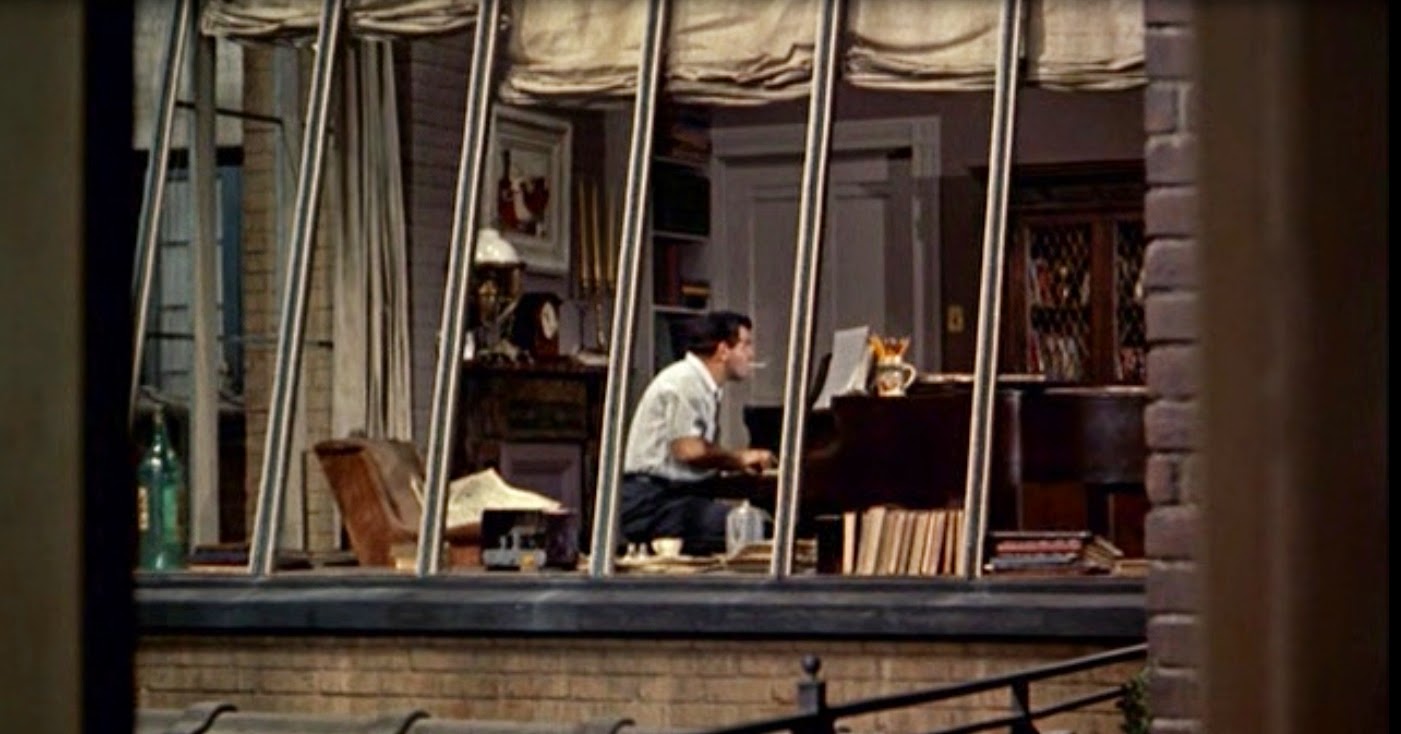
The courtyard set of Alfred Hitchcock's Rear Window (1954) is not a cutaway set, but it shares many of the qualities of a cutaway set. 


The elaborate boarding house set that Jerry Lewis created for The Ladies Man (1961), which was used extensively throughout the film, left a lasting impression on viewers. 


Jean-Luc Godard, a French filmmaker who admired Lewis' work, designed an office set similar to Lewis' boarding house set for Tout va bien (1972).

 
Another homage to Lewis' set turned up in Absolute Beginners (1986).  It is also a boarding house.


Jameson pointed out the similarities of Lewis' boarding house and the restaurant Le Hollandais from Peter Greenaway's The Cook, the Thief, His Wife and Her Lover (1989).  Jameson wrote, "Greenaway is cutting between different sets here, but his montage achieves a somewhat similar effect."  Both the restaurant and the boarding house are buildings with many different candy-colored compartments. 


A series of compartments with flamboyantly diverse designs appear in the 1998 music video for The Smashing Pumpkins' "Ava Adore."  Jameson wrote, "Obviously, the further we get from 1961, the less certain it is that any particular film is directly influenced by The Ladies Man.  Nonetheless, the video that Dom and Nic directed for Smashing Pumpkins’s 'Ava Adore' must count as some kind of descendant."


Martin Scorsese's Gangs of New York (2002) features a nightmarish version of Lewis' boarding house.  Methodist missionaries have converted an abandoned brewery into a warren of dark, cramped apartments to house the poor.


Finally, we have another cutaway ship set from The Life Aquatic with Steve Zissou (2004).


The Tramp and the Black Boxer

 
Film critic Matthew Dessem recently wrote that Buster Keaton's The Playhouse (1921) is "not particularly beloved today" because it features Keaton performing in blackface for a minstrel act.  Click here for the full article.  A reader, who calls himself Mr. Neutron, expressed doubt about this statement.  He wrote, "[The Playhouse is] still widely regarded as one of Keaton's most dazzling and creative shorts. Yes, the blackface act is disconcerting for a modern audience, but Keaton isn't using it for racist purposes.  Keaton's playhouse is full of the sort of acts one would expect to find in an old-time playhouse, and the blackface is just one of them.  Keaton's reliance on racist stereotypes in films like College is more objectionable, as is the anti-miscegenation gag in Seven Chances, though such material would have raised no eyebrows at the time."  I discuss the race issues of College and Seven Chances in my book The Funny Parts, but it never occurred to me that the minstrel scene in The Playhouse could qualify as racial humor.  It is Keaton using innovative camera tricks so that he can play all nine performers in a traditional minstrel act.  Nothing about the scene directly addresses race.


Of all the silent film comedians, Charlie Chaplin is one who usually falls under the radar in discussions of black stereotypes in silent comedy films.  Chaplin was well known for his left-wing political views.  He made it clear in his films that he opposed the idea of bullies, whether a street tough, a fascist government official or an unfeeling capitalist, victimizing the little guy.  So, then, what did he think about the civil rights of blacks in the United States?  I am sure that, if he was ever asked, he would have expressed his wholehearted support of blacks and other minorities.  The comedian appears to have been respectful of other races in that he didn't generally trade in ethnic humor.  But the fact was that blacks were generally absent from his films.  This sort of exclusion could be considered unfriendly to the black community.  Is it better to have black characters share in the pratfalls and other buffoonery or to render them virtually invisible?

I can think of only two instances in which a black character turned up in a Chaplin film.  The first time occurred in one of Chaplin's early Keystone comedies, His Favorite Pastime (1914).  It must be taken into consideration that the film was made before the comedian had control of his films.  The film largely represents the Keystone style of the day.  Let's go to the scenes in question.  While visiting a bar, Chaplin has an encounter in the bathroom with a black shoeshine boy.  The role is played by Billy Gilbert, a white actor in blackface.  It wasn't uncommon in 1914 to see a comedian in blackface in a film.  It should be noted, though, that, during this period, blackface entertainers were far more prevalent on the vaudeville stage than the movie screen.  Theater owners gave blackface singers and comedians prominent billing in newspaper ads because, for whatever reason, this was a form of entertainment that their patrons enjoyed.  By comparison, Hollywood went lightly on this form of entertainment.  In His Favorite Pastime, Gilbert manages in his portrayal of the shoeshine boy to slouch and shuffle, which is meant to indicate that the character is lazy.  He is dim-witted, too, based on his dull, slack-jawed expression.  We know that Chaplin's character has drank too much by the fact that he is stumbling around the bar.  In the bathroom, he bumps into a swinging door and loses his hat.  The shoeshine boy retrieves the hat for Chaplin and then grins unctuously in the hope of receiving a tip.  Chaplin glowers blearily at the shoeshine boy, who then makes his interest in a tip more obvious by holding out his hand.  Chaplin becomes so annoyed by this vulgar solicitation that he puts out a match in the shoeshine boy's hand.  Humor can be derived from a service worker annoyingly soliciting a tip without bringing race into it.  The use of this black character is, in the end, gratuitous and tasteless.


Later in the film, Chaplin performs an old stock routine in which a comedian comes up behind a shapely young woman and is shocked to discover that the woman is black.  The woman is played in blackface by a white actress, Helen Carruthers.  This is a more harmless routine, which I have discussed at length in The Funny Parts and previous blog posts.


To my knowledge, many years passed before another black character appeared in a Chaplin film.  That character was a boxer portrayed by an actual black actor, Victor Alexander, in City Lights (1931).  His appearance is brief.  Chaplin observes Alexander kissing his lucky rabbit's foot before a fight.  Chaplin is respectful towards the man and asks to borrow his rabbit's foot to bring himself luck in his own match.  The perception of black people as superstitious was stubborn, lingering in the minds of Hollywood screenwriters long after most other perceptions had been abandoned.  It isn't something that was necessarily wrong or evil.  The idea, simply, was that black people were spiritual and that spiritual people are more likely to put trust in unseen forces.  The boxer is ready for his fight.  He is vigorous and focused.  He is a much better representative of the black community than the blackface clown who shuffled around the bar bathroom 17 years earlier.  But the payoff of the scene is that the black boxer is dragged back into the locker room unconscious.  Maybe, a lucky rabbit's foot is not all that it's cut out to be.

 
I do not find the lucky rabbit's foot gag to be disconcerting or offensive.  Am I wrong?  My family comes from Naples, Italy, and Napolitanos have long had a reputation for being superstitious.  Would it offend me if Chaplin had made the boxer Italian?  No.  Of course, I have to admit that, if the Italian boxer was greasy and was waving around a lucky clove of garlic, I would have a different opinion.  But Chaplin is not out to make the boxer a grotesque figure.  The boxer is just man trying to bring some good luck his way.  I freely admit that I, myself, sometimes pray for good luck.  I prayed today because I learned that one of my Facebook friends had surgery.  Can a rabbit's foot be someone's prayer?  It's a hard question to answer.  The Civil Rights Movement was led by a spiritual man, Martin Luther King, Jr., who believed in the power of prayer.  I don't see him as a superstitious fool, but he might not be held in high esteem today if he brandished a rabbit's foot while he stood on the steps of the Lincoln Memorial and made his "I Have a Dream" speech.  Of course, King wasn't trying to get laughs.  Comedy is meant to be self-depreciating. 

My point is that a person should not be quick to dismiss a gag as racist and vile without stopping to consider if the gag unfairly degrades an entire race of people.  Examine the context of the gag before you condemn it.  What is the message?  What is the filmmaker's objective?  The minstrel act in Keaton's The Playhouse is a wonderful example of filmmaking.  It is clear in my mind that it is not racist. 

Simulated Scotch


A novel comedy routine showed up on theater screens in 1955.  Oddly, the routine was featured in two unrelated films, which happened to be released only two weeks apart.  In You're Never Too Young (1955), Jerry Lewis must hide the fact that he emptied a bottle of Scotch.  His solution is to cleverly mix products from a first aid cabinet to create a concoction that has the taste and color of Scotch. 

You're Never Too Young (1955)


In Mister Roberts (1955), Ensign Pulver (Jack Lemmon) has convinced a nurse to go on a date with him by promising to share a rare bottle of Scotch with her.  Unfortunately, the bottle that he expected to use is no longer available.  His friends, Roberts (Henry Fonda) and Doc (William Powell), come to his assistance by creating simulated scotch out of pure alcohol, Coca-Cola, iodine and hair tonic.

Mister Roberts (1955)


Funny Tidbits for June


Allow me take care of some miscellaneous business today.

Here is a Charley Chase performing the "trying on hats" routine in At First Sight (1924).


This is Buster Keaton performing an early version of his "unconscious woman" routine in The Navigator (1924).


A folding bed gets the best of Jerry Lewis in You're Never Too Young (1955).

  
Charlie Chaplin is still running afoul of his old nemesis, the dress dummy, in Monsieur Verdoux (1952).


Here are three brats from The Band Wagon (1953).

  
The Three Stooges perform the three-man human pyramid gag in Healthy, Wealthy and Dumb (1938).


I have written much about Karno's "Mumming Birds" sketch in the past.  I just recently learned Max Linder starred in an unauthorized film adaptation of "Mumming Birds" in 1907.  The film was called Au music-hall, which translates as At the Music Hall.
 
These stock comedy bits are further proof to me that comedians never tire of a good routine.


One last silly clip